05 March 2012

Comparison of Commonwealth Honours and Awards

This post is a further effort to include some interesting articles and research about medals on this blog. I have asked a member of the British Medal Forum if I can reproduce a chart he has worked on that attempts to show a comparison of Honours and Awards between the United Kingdom, Canada, New Zealand and Australia. I thank Mark Brewer very much for his kind permission to show his work here.
Mark will be the first to admit that there is no clear cut alignment of the different honours systems and not all awards are alike or equivalent. Mark used his own extensive knowledge of the different systems and input from the BMF members to complete the following research.


NATIONAL HONOURS
United Kingdom
Australia
Canada
New Zealand
Civilian & Military
Civilian & Military
Civilian
Military
Civilian & Military
Knight or Dame Grand Cross of the Most Excellent Order of the British Empire (GBE)
Companion of the Order of Australia (AC)
Companion of the Order of Canada (CC)
Commander of the Order of Military Merit (CMM)
Knight or Dame Grand Companion of the New Zealand Order of Merit (GNZM)
Knight or Dame Commander of the Most Excellent Order of the British Empire (KBE/DBE)
Knight or Dame Companion of the New Zealand Order of Merit (KNZM/DNZM)
Commander of the Most Excellent Order of the British Empire (CBE)
Companion of the New Zealand Order of Merit (CNZM)
Officer of the Most Excellent Order of the British Empire (OBE)
Officer of the Order of Australia (AO)
Officer of the Order of Canada (OC)
Officer of the Order of Military Merit (OMM)
Officer of the New Zealand Order of Merit
(ONZM)
Member of the Most Excellent Order of the British Empire (MBE)
Member of the Order of Australia (AM)
Member of the Order of Canada (CM)
Member of the Order of Military Merit (MMM)
Member of the New Zealand Order of Merit
(MNZM)
Medal of the Order of the British Empire for Meritorious Service (BEM)
Medal of the Order of Australia (OAM)
No equivalent
No equivalent
No equivalent
 

GALLANTRY AWARDS
United Kingdom
Australia
Canada
New Zealand
Victoria Cross (VC)
Victoria Cross for Australia (VC)
Victoria Cross (VC)
Victoria Cross for New Zealand (VC)
Conspicuous Gallantry Cross (CGC)
Star of Gallantry (SG)
Star of Military Valour (SMV)
New Zealand Gallantry Star (NZGS)
Distinguished Service Cross (DSC),
Military Cross (MC),
Distinguished Flying Cross (DFC)
Medal for Gallantry (MG)
Medal of Military Valour (MMV)
New Zealand Gallantry Decoration (NZGD)
Mention in Despatches (mid)
Commendation for Gallantry
New Zealand Gallantry Medal (NZGM)

BRAVERY AWARDS
United Kingdom
Australia
Canada
New Zealand
George Cross (GC)
Cross of Valour (CV)
New Zealand Cross (NZC)
George Medal (GM)
Star of Courage (SC)
New Zealand Bravery Star (NZBS)
Queen’s Gallantry Medal (QGM),
Air Force Cross (AFC)
Bravery Medal (BM)
Medal of Bravery (MB)
New Zealand Bravery Decoration (NZBD)
Queen’s Commendation for Bravery,
Queen’s Commendation for Bravery in the Air
Commendation for Brave Conduct
New Zealand Bravery Medal (NZBM)

Gilbert Young - Australian Service Medal 1939-45

W28634 Gilbert Young was 48 when he enlisted for service in WWII. At that age it is not surprising that he remained a member of the militia and did not serve with the 2nd AIF. This is indicated by the W prefix of his service number rather than the WX for the AIF.
By using Ancestry, the WA Birth, Deaths and Marriages data base and the Karrakatta Cemetery search page, I was able to put together a family tree for Gilbert's daughter Edna. I knew that her husband Arnold Keith Fleming had served with the RAAF during WWII. I was also able to establish that their son Alexander Keith Fleming served during the Vietnam War as a rifleman with 3 RAR during their 2nd tour. Alexander returned to Australia from South Vietnam in mid May 1971 but was unfortunately killed in a motor on 29 August 1971. He is buried at Karrakatta as well. Alexander, or Flemo, is the centre soldier of the three pictured below.


However, all these clues lead to nothing. Even though I knew what Gilbert's daughter's name was I could not find any clue to her current address or even if she was still alive. I also had no lead on their daughter after 1980.
Bill solved the final piece of the puzzle and today he located Edna who I have since spoken to.
This medal was sent to me by the WA RSL. The medal returned tally is now 1083.

04 March 2012

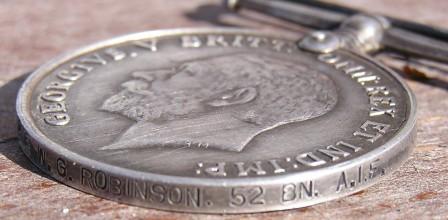
James Ford - WWI British War Medal

This is another example of a family who sacrificed much during WWI. Tim has put together the whole story based on Bill's initial research. This is how Tim has told me the story:

'James Ford was born in 1888 in Brisbane to parents James and Mary Ford. He had five brothers William, Robert, John (Jack), Michael and Richard and they hailed from the West End/South Brisbane area.
Robert (24 years of age) and William (22 years of age) enlisted in the AIF together on 29 July 1915, joining the 11th Reinforcements of the 15th Battalion and being assigned the numbers 3296 and 3298 respectively. James (27 years of age) enlisted on 15 September 1915, also being assigned to the 15th Battalion and was issued with the number 4789. Robert and William sailed for Egypt on 24 September 1915 with Robert joining the 15th Battalion after further training on 6 March 1916. Instead of joining the 15th, William joined the 47thBattalion, known as the 15th's 'pup' battalion, formed when the AIF's 1st and 2nd Division battalions were split to form two extra Divisions in March 1916.
James sailed to Egypt with the 15th Reinforcements to the 15th Battalion on 5 May 1916. After training he finally joined the battalion and his brother Robert on the Western Front on 4 October 1916.
On 1 February 1917 during at attack on Stormy Trench (where Mad Harry Murray won his VC) at Gueudecourt, Robert was listed as Missing in Action. It was subsequently discovered he had been captured by the Germans. He spent the remainder of the war in a Prisoner of War camp in Germany. William was Killed in Action serving with the 47th Battalion during the Battle of Messines on 7 June 1917, after receiving a gun shot wound.
James remained with the 15th Battalion, surviving its major actions throughout 1917. After being twice wounded during 1917 he was Killed in Action by a shell whilst the battalion were in a support trench near Hebuterne on 27 March 1918, where they had been rushed to stem the German spring offensive. James was buried nearby and a cross erected by his comrades. Unfortunately, his grave was lost during further fighting. He has no known grave and is commemorated on the Villers-Bretonneux Memorial. 
Robert was repatriated from Germany after the Armistice and returned to his father and mother in Brisbane in mid 1919, passing away in 1926. Of the three Ford sons who sailed for war one survived the atrocious conditions of a POW camp, but died young, and two paid the supreme sacrifice. 
Richard, who had been born in 1900 was thankfully too young to go to war and married Mary Agnes McDonald in 1930. They had children including a son named Gary. On 4 March 2012 after Bill had done the hard lead up work I was able to track down James Ford's nephew Gary and his wife Gloria in Brisbane.
Interestingly, I see that there is a number missing in the 15th Battalion series between William and Robert (3297). I think it likely that either James or another brother also attempted to enlist with them, but was turned away for some reason. A witness in William's Red Cross file mentions there was another Ford brother also in A Coy of the 47th. None of the other Fords in the 15th or 47th Battalion match the family and the witness was a 47th Battalion reinforcement having no links to the 15th, so is unlikely to have got the other brothers confused. Perhaps this means another brother enlisted under a false name, perhaps Gary's father Richard who was born in 1900 enlisted under age?'


James' medal has had a hard life and appears to be fire damaged. The rim has taken several knocks and it was quite difficult to get a clear photo of the naming. The returned medal tally is now 1082.


03 March 2012

Arthur Chaloner Smith - WWI Victory Medal

The destructive impact of WWI on Australian families is very evident in the following story. It goes to show how some family lines were completely cut. This often makes it difficult for us as we have to start searching for a relative who is often quite distant to the soldiers we are researching. 
That is what happened in this particular case and it was only through some great detective work by Tim that the case has been solved. This is what Tim has put together:
2707 PTE Arthur Edward Chaloner Smith, known as ‘Ally’, was born in 1873 in County Wicklow, Ireland, the only known child of John Chaloner Smith and Mary O’Shaughnessy. He subsequently emigrated to Western Australia and married Ada Rebecca Rudyerd (nee Lamb) from Naracoorte, South Australia in 1902. Ada was previously married to Jack, however, it did not last. Jack and Ada settled in Perth and they had a son named Jack in 1905, but he died the following year.   
Ally enlisted in the AIF on 21 June 1916 as a 41 year old, joining the 8th Reinforcements to the 16th Battalion. He served with A Company of the 16th Battalion at Gallipoli, in Egypt and on the Western Front prior to being Killed in Action in Belgium during the Battle of Messines on 12 June 1917. 
Ada had two sisters one of whom, Charlotte Augusta Lamb, married Campbell Mehaffey at Naracoote in 1892. The other sister does not appear to have married. Charlotte and Campbell had a number of children including SGT John Lamb Mehaffey known as 'Little Jack', who was Killed in Action in France whilst serving with the 50th Battalion on 2 April 1917 and PTE Campbell William Graham Mehaffey, who was Killed in Action in Belgium serving with the 6th Field Ambulance on 5 November 1917. A third son was Darcy Gerald Arthur Stock Mehaffey born in 1897, who had a child named Campbell born in 1920, the namesake of his lost uncle. 
Ada remained close to the Mehaffey family until her death in 1926. The photos below are of 'Little Jack' and Campbell. The medal will be sent to the Mehaffey family.
The returned medal tally is now 1081. 


MEHAFFEY, John Lamb

Picture
Service no 3418
Sergeant
50th Battalion (late 10th Battalion)
Born 25 February 1894 at Naracoorte
Son of Campbell Mehaffey of Naracoorte
Occupation prior to enlistment Clerk
Enlisted 4 August 1915
Served in Egypt, France and Belgium
Reported missing, Norieul, later reported killed in action

Studio portrait of 3418 Sergeant (Sgt) John Lamb Mehaffey of Naracoorte SA who enlisted as a Private in the AIF on 4 August 1915. Pte Mehaffey embarked in Adelaide on 27 October 1915 as an acting Corporal with the 11th Reinforcements to the 10th Battalion bound for Egypt and on arrival was promoted to Acting Sergeant. When the AIF was re-organised in early 1916 he was transferred to the 50th Battalion, he reverted to the ranks, although he was quickly promoted to Corporal and sailed with the 50th Battalion on 5 June 1916 on board HMT Arcadian bound for Marseilles. After arrival in France he was promoted Sergeant on 9 July 1916. On 2 April 1917 Sgt Mehaffey was first reported as missing in action, amended to killed in action, when the details of his death in fighting on the outskirts of the French village of Noreuil were eventually reported. It is recorded in his file; "Buried in Australian Military Cemetery on outskirts of village and big cross erected by the Battalion." It is likely his grave was destroyed in subsequent fighting as today Sgt Mehaffey has no know grave. His name is commemorated on the Australian National Memorial at Villers Bretonneux, France. In the Roll of Honour circular completed by his mother she recorded that his brother, Pte C.W. Mehaffey, 6th Field Ambulance, was killed in Belgium the same year on 5 November 1917.
Picture Service No. 3418
Sergeant
50th Battalion A.I.F.
Born on February 25, 1894 at Naracoorte, South Australia
Son of Charlotte Louisa (nee Lamb) and Campbell Mehaffey
Occupation prior to enlistment – Clerk
Enlisted on August 4, 1915 at Adelaide, South Australia
Served in Egypt, France and Belgium.
Killed in action at Noreuil, France on April 2, 1917 aged 23 and buried at Noreuil.  He is commemorated at Villers-Brettoneux, France.
Sergeant Mehaffey’s brother – Private Campbell William Graham Mehaffey was killed on November 5, 1917 aged 21 in Belgium and is buried in the Hooge Crater Cemetery, Zillabeke, Belgium.

MEHAFFEY, Campbell William Graham

Picture Service no 17145
Private
6th Field Ambulance (Detached to 7th Fd Amb)
Born 7 April 1896 at Naracoorte
Son of Campbell Mehaffey of Naracoorte
Occupation prior to enlistment Draper
Enlisted 3 August 1916
Served in France and Belgium
Made the supreme sacrifice 5 November 1917 at Ypres


Photos and text - http://www.ww1sa.gravesecrets.net/m.html

27 February 2012

John Schmitzer - 1939-45 Star

This WWII 1939-45 Star was awarded to NX122770 John Schmitzer and he was known as Jack. From the electoral rolls I knew he was from a large family who lived in the Taree area. Lucky, Jack was mentioned in an Ancestry family tree and the tree owner was able to put me in touch with Jack's nephew
Thank you to Anne who helped me with this search and to Liz J who sent me the medal in the first place.
The returned medal tally is now 1080.

26 February 2012

Website Update

Today, Scott updated our website. By clicking on the Site Update button on the left side of the page, below the hit counter, you will see what is new.

25 February 2012

Robert Adams - British War Medal


This post was updated on 12 May 15. Please scroll to the bottom.
 
This particular search has been typical of many that we do. We often get a lot of information initially that seems to be leading us to an easy result. However, as is often the case, we end up getting to a point where all the information seems to dry up. 
I received the BWM awarded to Lieutenant Robert John Adams in Feb 09 and there is a fair amount of information about him and his early life in Tasmania. All the leads I had dried up in about in the mid 1920s. Tim has had a fresh look at this case and has had a wonderful bit of success. Here is what Tim has put together.

Robert John Adams emigrated from the Ditton, Lancashire with his wife Leah to Tasmania prior to WW1. They appear to have separated in Hobart around the start of the war, with three children (Robert, Leah and Trixie), being left in the care of a Mrs Fitzpatrick. Robert was a Boer War veteran and former British Army RAMC regular serving 4 years with the colours and 8 in the reserve. 
Robert somehow made it to Townsville and enlisted there in March 1915, initially serving with the 4th Light Horse Brigade Field Ambulance, being transferred to the 15th Field Ambulance in March 1916 in Egypt. He then served in France/Flanders being commissioned to LT from LCPL at the end of the war. His service papers and an allotment file explain the situation with his children and wife.
When he got home to Tasmania after the war Robert and Leah divorced (Hobart Mercury article July 1924). He subsequently married a lady named Revie and they had children named Jan, Roberta, Robin, Jill and Simon. He served on as a CPL in WW2, reducing his age by 8 years. Robert appears to have copped a few mentions in the paper over the years, including one in which Revie was injured in a traffic accident.
Robert died on 21 November 1953 and this time was living at Windsor St, Kingston Beach, Hobart. In the notice of death in the Hobart Mercury his family members were listed, including his daughter Leah who was by then married with the surname Uhr-Henry. 

This is the information that Tim used to track down Leah's son David who is now living in Victoria. The medal was sent to me by the Directorate of Honours and Awards after it was initially handed in by Adrian N of Hornsby.
 The returned medal tally is now 1079.


Post update 12 May 15.
Yesterday I received a very unexpected email from Marg Powell of the John Oxley Library. As part of her research in to the library's collecting she came across this story about Robert Adam. In the collection is a picture of Robert taken in Cairo. How amazing that this picture is connected to this story. I've provided Marg with the family's contact details so that they can also see this photo. The library's WWI blog is at this address.
Thank you to the John Oxley Library for kind permission to reproduce this picture.
W. O. J. Kielly Papers, John Oxley Library, State Library of Queensland

24 February 2012

Matthew Abbott - British War Medal

I received this British War Medal in 2007 from the Queensland RSL after it was handed in. It was awarded to 6519 PTE Matthew Abbott who served in the 25th Battalion, AIF.  Matthew's next of kin were his parents Matthew Snr and Harriet Louisa Abbott of Gympie Road, Kedron. Matthew had two brothers named Arthur and 3755 Lance Corporal Frank Abbott, also of the 25th Battalion. Frank was killed in action at Zonnenbeke, Belgium, on 31 October 1917. Matthew senior passed away in 1939. We also know that Matthew had no children of his own as he never married.
Arthur Abbott married Sarah Bowley who was known in the family as Myrtle. Myrtle had a nephew named Gordon whose mother died when he was young and he was raised by Arthur and Myrtle.
Gordon's father, Cyril served with the 26th Battalion in WW1 and there is a photo of him in the Queenslander from June 1915 (reproduced here).

BOWLEY, Cyril Claude

Picture Service no 280
Private
26th Battalion
Born Brisbane, Qld
Son of J. STARKEY
Enlisted 15 April 1915 at Brisbane, Qld.
Occupation prior to enlistment Grocer
Returned to Australia 23 April 1919 per 'Kashmir'

The Queenslander
Sat. 26 June 1915


Tim has done some great research on the back of the initial work done by Bill to finalise this search. The medal will be returned to Gordon's daughter who is Arthur and Myrtle's grand niece.
The medal returned tally is now 1078.


GNR R.H. Wilcockson - British War Medal

This is the story of a British War Medal that has travelled a very long way only to end up being a few kilometres from its final destination.
This BWM was awarded to 46246 Gunner Robert Henry Wilcockson. Initially, Robert enlisted in to the Royal Artillery, later in the war he transferred to the Royal Engineers and in 1919 he was serving with the Green Howards. Luckily, I was able to piece together his service history as his British Army pension records is available online via Ancestry. This document also gave me information about where Robert was from and his wife's name.
Using other bits of information I found online I was able to piece together a family tree for Robert and his wife Henrietta. The key piece of information was that one of their sons was named Joseph Howard Wilcockson. This information led me to find a family tree on Ancestry that showed Robert, Henrietta, Joseph and two other children. I sent the tree owner a message and within six hours I had a response.
Robert and Henrietta's son Joseph also had a son Joseph. The tree owner is Joseph juniors son named Mark. This makes Mark the great grand son of Robert. The information I was able to piece together was that the family originated in Lancashire, UK, and that they didn't venture too far.
Part two of this story is how the medal got to me. In 2007 an acquaintance of mine, Paddy D, in Townsville who manages the 4th Field Regiment historical collection asked me to research this BWM. It had been sent to him from his family in New Zealand who had found the medal amongst the belongings of a relative who had recently died. How the medal got to Auckland is a mystery.
In my message to Mark I told him all this and based on what I could see I thought I would be sending the medal back to England. In his response Mark told me that the family had stayed in North Lancashire except for him. Much to my surprise Mark now lives in Canberra and only about 10km from where I live. I have arranged to meet him next week and hand him the medal. I am quite amazed that this medal has travelled so far and now it turns out to be so close to a direct descendent of Robert Wilcockson.
The returned medal tally is now 1077.

21 February 2012

Imperial Service Medal - James Gibson

The Imperial Service Medal is not one that usually comes my way so it is nice to have something out of the ordinary to do some research on. This particular medal was awarded to James Sydney Gibson for his service as a Signalman with the NSW Tramways. The only information about the award being made to James that I could find was in the London Gazette and on the itsanhonour web page.
I've recently tracked down James' grandson and I'll return the medal to him in the near future.
The returned medal tally is now 1076.

18 February 2012

WWI British War Medal to Wilfred Robinson

This story is has many elements of luck about it. The BWM awarded to 3415 PTE Wilfred Gerald Robinson was given to me by a friend of mine who was in my Staff Collage class. When I received the medal last August I found a lot of information about this soldier which included his WW2 service, the names of his sons, that he died in 1970 and where he was buried. All clues ran out with the death of his wife in 1985.
Yesterday, I decided to have another look at this medal and stumbled across a family tree on Ancestry which had Wilfred listed. The tree hadn't been accessed for seven months so I was relying on a bit of luck again. Within an hour of sending a message to the owner I had an email response and a request to ring her.
As it turns out the lady why published the tree had done so for her sister in law who is the carer of Wildfred's son Eddie. Eddie is a WWII veteran himself and not in good health so all these pieces of luck have come together at a great time so that Eddie will get his father's medal back.
Thank you to Angie C for sending me the medal and also to Bunny and Carol for their interest in Eddie and his story.
The returned medal tally is now 1075.

09 February 2012

Female WWII War Medal

Over the years we have had only a small number of medals awarded to females come to us. This war medal was awarded to WF57093 Bertha Florence Corkery who was originally from WA before marrying and moving to Boorowa NSW.
Boorowa is a smallish country town but there was a large Corkery family there. Ancestry provided most of the clues to track Bertha and several family trees for this family have been published. I sent a message to the tree owners and today I was contacted by Bertha's grand daughter, Jess. I was rather pleased with this bit of research as I only received the medal yesterday. Even more pleasing was to find out that Jess lives in the next suburb from me and she came straight over to collect the medal.
Along with the picture of Bertha's medal is a copy of the news paper photo from her wedding.
Well done to LTCOL Mick C who sent the medal to me.
The returned medal tally is now 1074.

07 February 2012

Late issue WWII medals

These two medals come with a very interesting story. The 1939-45 Star and Australian Service Medal pictured below were awarded to H2896 David James Harold Hicks.
When they arrived in the mail I was very surprised to see that the box was a modern issue from the Directorate of Honours and Awards and not of 1950 vintage. Then I looked at the naming and saw is was laser engraved. I know that this method of engraving started after 1992 so the medals were issued after that year.
One of the reference books I use is Australians Awarded by Clive Johnson. In this book Clive provides excellent information about naming styles and different variants of the same medal. As it turns out the ASM has three types. The first type was issued from 1952, when stocks of this type ran out a type 2 was produced and eventually a type 3. There a subtle difference between the three types but when you know what to look for it is easy to work out which type it is.
The ASM to Hicks was the first type so I suspected that it was issued in the mid to late 1990s. There is no duplicate marking so it is an initial issue. What is also unusual, which can be seen in the pictures, is that the medal is named in the following sequence: Initials, Name then Number which is different from earlier times when the Number is first.
While searching for Hicks I ran in to the usual brick walls. Even though his service record was available on line it gave little information, except for one very important clue, his wife's name is Pauline. Based on this I spent a few hours using Ancestry to track the family. Unfortunately, there was only one electoral roll entry for David in 1954 and nothing for Pauline.
The next clue I got was a suburban war memorial entry which provided David's date of death in 1995 and then the trail went very cold. It was time to take a few punts. The Tasmanian birth, death and marriage indexes are not on line and cost a fee to access so that was out of the question. So, I looked for any burial information and came across a Hobart cemetery which listed David's burial. It also gave the suburb where he lived. A further search did not show that Pauline was buried in the same cemetery. I started to wonder if she might still be alive.
I took another punt and found a P Hicks listed in the White Pages who lived in the same suburb so I rang the number and sure enough I had found the family.
As it turns out, after David died his daughter noticed an anomaly with David's medals so she wrote to Honours and Awards. This was in the late 90s. The medals were then issued, however, I now know they were incorrectly addressed. They eventually came to me and thanks goes to Carole and Michael for wanting to see the medals go to the correct family.
The returned medal tally is now 1073.


04 February 2012

Victory Medal to WWI died of wounds

6290 William St Clair Orr served in the 9th Battalion AIF having enlisted on 10 Jan 16. He left Australia in September 1916 and got in to a bit of trouble on the voyage and was charged with AWOL on two occasions. His troop ship arrived in England in mid December and William joined his battalion in France on New Years Day 1917.
The war diary shows that in early January the battalion was required to provide working parties and the entry for 5 Jan 17 says:
'8 casualties in one of our working parties of "semi trained" reinforcements, 5 being killed and 3 wounded.'
One of these was William who received gunshot wounds to his abdomen, legs and right hand. William died of his wounds later that day at the 3rd Field Ambulance.
William's came from a large family that was centred on Grafton NSW. His medal was sent to me by Liz J from northern NSW so the medal became lost up that way somehow. While there are still branches of the family around Grafton I was able to trace William's eldest brother's family to Sydney. William's Victory Medal will be returned to his great nephew.
The returned medal tally is now 1071.

01 February 2012

WWII Australian Service Medal 1939-45

The parcel that was sent to me that contained the Robson medals also had a single 1939-45 ASM awarded to NX115779 Brian Thomas Birrell. I took about an hour to trace the family through the Electoral Rolls and the Ryerson Index and I have just spoken to Brian's wife.
How the medal was first lost and then put with the Robson medals is anyone's guess. Mrs Birrell tells me that she has been looking for this medal for years as she has the rest of Brian's group. Not only is the medal being returned to the family it is being reunited with the others awarded to this soldier.
The medal returned tally is now 1070.

WWII medal group of four

The WWII medals awarded to NX114199 Matthew Robson have had an eventful life.
Matthew was originally from Wollongong. After the war he worked as a plumber and eventually settled in the Blue Mountains. After Matthew died, over 30 years ago, his possessions were collected up and consigned to the rubbish. On the way to the tip a bag of clothes fell off a trailer and were picked up by Cheryl who was following behind. Cheryl found the medals in the clothes and held on to them until forwarding them to me this year.
I was able to track down the names of Matthew's siblings and located a family tree on Ancestry. The tree owner knew little about Matthew but was able to provide the name of his son, Colin. All I could find on Colin Robson was that he died in 2006 and his death notice was published in the Armidale Express. I then sent a letter to the editor of this paper which was published on 1 Feb 12.
Today I have received information which has put me in touch with Colin's son, which of course is Matthew's grand son.
The medal returned tally is now 1069.

WWII War Medal

This WWII War Medal was awarded to 161760 John Albert Reynolds. Bill has recently located John's son and the medal will be returned to him in the near future.
The medal came to us from the NSW RSL and the returned medal tally is now 1065.

WWII Merchant Navy medal

The search for the family of James Edwin Morrison was a difficult one. I received his medal in 2008 and didn't get very far. The only information I had was the WWII nominal roll entry as Merchant Navy records are not readily available.
Morris took this one on and ended up purchasing James' death certificate. This gave us the names of James' son and from there it was a rather easy search. James' grandson has posted a family tree on Ancestry so I contacted him through that. The key was James' son's name, so thank you Morris.
Thank you also to Geoff of Eatons Hill who sent me the medal originally.
The medal retuned tally is now 1064.

28 January 2012

Honours List

I have received many emails, phone calls and messages of congratulations following the announcement of Australia Day Honours List. Thank you all very much.
One of the comments on the initial blog entry requested a picture of the medal. Below is the Medal of the Order of Australia and then a picture of my ribbon bar as it now looks. I should receive the medal at an investiture in March or April and I'll post more pictures then.
Thank you all once again.

War medal to Robert Stein

Quite often we contact a family who don't realise that a close relative was awarded medals and that they have been lost. That is the case with the 39-45 War Medal awarded to VX127540 Robert Stein. It is probably a whole lot easier to tell the story through Bill's thread about this search on the Australian Surname Group.

The returned medal tally is now 1063.

27 January 2012

Australia Day 2012

Yesterday, I was very honoured to be recognised in the Australia Day Awards with the Medal of the Order of Australia. The award was made for services to veterans and their families and I feel rather humble that what I do is worthy of national recognition.
I would not have been able to achieve the success I have without the assistance of many others. My research team work tirelessly searching through records, both physically and on line, to locate the family of the service men we are looking for.
Bill, Morris, Alex, Tim and Nicole have my eternal gratitude for their continued unselfish research efforts.
Scott continues to be my man in Queensland and our website would not exist without him.
The internet remains the medium through which most of our research is done. While there is a lot of information available it is not always readily to hand. We are very lucky to be associated with the Australian Surname Group which is made up of members with an extraordinary ability to find that vital bit of information that helps us solve so many cases. Thank you doesn't seem to say enough for the assistance that the Yuku team provides us.
In the background I have a wonderful group of friends who I first met through the Australian Light Horse forum. This gang is the most supportive and riotously fun group I know. They made my early research possible and today remain the closest of friends.
Then, of course , there is Anna, Grace and Rhys who put up with everything.
Thank you to everyone.

18 January 2012

Norman Brown - WWII War Medal and Civilain Service Medal

This is an unusual WWII group awarded to NX52688 Norman Brown. The group consists of the WWII War Medal and the Civilian Service Medal. This is the first of these medals that has come to Lost Medals Australia and while not rare there was only 6711 of these medals issued. By reading the Australian Surname Group thread about this search you will get an idea how complicated it was.
This medal will be returned to Norman's son and is from the NSW box. The medal returned tally is now 1062.


13 January 2012

John Clark - WWII Defence Medal

This return is very satisfying. The medal is just a single of a larger group, it is the Defence Medal which was awarded to most who served in WWII and there is really nothing special about it. However, it is all the minor things that make it special.
Most medals we return are to an infantryman and usually an other rank. This Defence Medal was awarded to NX57693 John Clark who was a Lieutenant and served with 112 Australian Light Anti Aircraft Regimental Workshop Section. This unit was responsible for maintaining and repairing the anti aircraft weapons used to defence against attack from the air.
Most importantly, this medal is being returned to John's daughter who we know is very emotional about getting this medal back.
This medal is from the NSW box and the returned medal tally is now 1060.

06 January 2012

Harold Claydon - British War Medal

In a post earlier this week I showed a picture of a British War Medal awarded to a RAN sailor with the rank of Boy 1 Class. That particular medal was awarded to 6252 Harold Francis Samuel Claydon RAN.
I managed to follow Harold through his life by using the archives and newspaper articles. However, I lost all leads following Harold's death in 1969. We then asked Yuku to see what they could find and we were soon provided with a photo of Harold's wife's memorial plaque which gave us his children's names. This in turn led to a series of phone calls that ended with me making contact with Harold's daughter Jill this afternoon.
The story is even more complete as I know how the medal was lost and when it was found. Seventy years ago the medal was found in Casino, NSW, following an Anzac Day parade. As can be seen in the picture the medal is broken from the suspender which shows how it fell off the ribbon. The same family held on to the medal until it was sent to me in November 2011. Thanks to Ron S for taking the first step to seeing the medal returned.
The returned medal tally is now 1059.

04 January 2012

Korean War pair to Able Seaman Daniel Albert Walsh RAN

Last October I briefly reported on several cases that Bill had successful resolved. One of the most difficult was locating the family of R38893 Able Seaman Daniel Albert Walsh. This particular case came to a conclusion when Bill personally returned Daniel's medals to his widow. The full story was reported in the Maribyrnong Weekly newspaper. We have also been kindly provided a copy by Leader Press which is reproduced below.
(Click on the photo for a larger view)

03 January 2012

Leslie Kairau RNZIR Vietnam War pair - update

Last December I wrote about a Vietnam War pair that was being returned to the wife of the veteran. Here is the story. Today I received a lovely letter from Leslie Kairau's widow letting me know that the medals arrived safely.
Mrs Kairau was also able to explain how the medals became lost. They were borrowed by a friend for a parade and remained in his safe keeping. He subsequently moved to Australia and through a set of circumstances the medal were eventually sold. Once Les found out about this he applied for and received official replacement medals and an additional two medals that he was entitled to. Now his family has the original medals back.

31 December 2011

Royal Australian Navy WWI rank - Boy 1st Class

I was having a look at some old posts and came across an early blog entry about low numbers on medals and unusual units. It occurred to me that over the years we have returned a medal to most ranks in the Army from Private through to Major General. We have also returned several medal groups to members of the RAN but most of these have been to the more common ranks of Ordinary Seaman or Able Seaman.
We are currently researching a single British War Medal awarded to 6252 Harold Samuel Claydon but what is unusual is that the rank on the medal is Boy-1, or in full, Boy 1st Class. This Wikipedai entry gives an explanation of the rank. Although the explanation relates to the Royal Navy rather than the Royal Australian Navy, I suspect that there would have been a lot of similarity between the two services.
These pictures show the naming in full and even the variations between hard and soft striking with some of the letters.

A History of the 1962 General Service Medal with South Vietnam Clasp

I recently read a very interesting article on the British Medal Forum written by Tony Rooney. Tony has kindly allowed me to reproduce it here.
I've edited the article slightly and removed the photos that Tony had included. The full article can be seen at this link, however, membership is required.

A History of the 1962 General Service Medal with South Vietnam Clasp (62 GSM with SVN clasp)

The early 1960’s saw the UK defence establishment move towards joint air, land and naval operations. Steps were in place to merge the Admiralty, the War Office, the Air Ministry, the Ministry of Aviation, into a single the Ministry of Defence. This merger eventually took place in 1964.
Embracing this new institutional spirit Her Majesty Queen Elizabeth the Second introduced new General Service Medal to supersede both the Naval General Service medal 1915 and the General Service medal 1918 which was awarded to the Army and the Royal Air Force. As with the previous General Service Awards, the new medal was also available to those Commonwealth countries that still subscribed to the imperial awards system.
What is important to note is that, although named the 1962 GSM, it was in fact not instituted until 6th of October 1964 under the new MOD’s order number 61. The reason the medal is named the GSM 1962 is because it was decided to retrospectively divide the end of the Brunei Campaign for which the old separate GSM’s were awarded and the ongoing campaigns in Borneo and Vietnam, at that time, with the new award.
On August 3rd 1962 the first 30 officers and NCO’s of the Australian Training team Vietnam (AATTV) arrived in Vietnam. They were initially allocated to Vietnamese training establishments at Dong Ha, Hiep Khanh and Duc My. The advisors to the Ranger Training Camp at Duc My were for the most part members of the Australian 1st SAS company which had been established 5 years earlier on 25 July 1957 (Malone, SAS A Pictorial History of the Australian Special Air Service). Additionally two officers were assigned to the ‘Combined Studies Division’ (CSD) a Central Intelligence Agency (CIA) organisation that operated out of Danang. (McNeil ‘The Team’)
It was these two CSD officers, Captain Peter Young and Captain John Healy who fired the first angry Australian shots of the war. On the 17th of August 1962, a helicopter that they were travelling in was forced to land with mechanical difficulties. Healy and Young repelled a Viet Cong assault on the downed aircraft, with the door gun they had stripped from the helicopter. (Davies and Mckay, The Men Who Persevered P.22) Captain Young joined the Australian Army, by taking a short service commission, after previous service in the British Army with 22 SAS in the Malayan Emergency (Young and Jesser, The Media and the Military) About 10% of all Australian troops who ultimately served in Vietnam were UK natives. Many of them, like Young, had previous service in British Forces.
The commander of AATTV, Colonel Ted Serong had been specifically proscribed by the Australian Department of External Affairs from engaging in combat or violating the neutrality of neighbouring Cambodia and Laos. (Woodard, ASIAN ALTERNATIVES) Serong ignored both of these edicts. The first Australians sent by Serong to assist the US Special Forces in their border ‘trail watch’ camps were drawn from the SAS Company men instructing at the Ranger Training Center Duc Lap. In his October 1962 report Serong admits - “Currently Sergeant Weir is visiting 20 Special Battalion (Rangers) in the Kontum area and Sergeant Simpson is visiting a Special Forces Village Defense Project near Lao Bao.”
For November 1962, Serong reported “Received a request from Col LAYTON, Combined Studies, to keep Sgt SIMPSON at (Khe Sanh)”.
At that time the border surveillance role was undertaken by Montagnard tribesmen led by United States Special Forces (USSF) troops. (Ahern, Vietnam Declassified) The program named the ‘Civil Irregular Defence Guard’ (CIDG) and would later be assumed by the US army, but at that time it was organised and financed by the CIA’s Combined Studies Division. (Methven, laughter in the Shadows) The Colonel Layton, Serong refers to was the CIA’s Gilbert Layton. (Petersen and Cribben, Tiger Men) The Sergeant Simpson referred to is Sergeant Rayene Simpson.

The Australians operating on the trail watch missions with USSF on the border were forbidden to cross the border into Laos and there is no official record of them ever doing so. However, given that, that is where the trails were; and that Serong ignored the stricture by personally flying reconnaissance over Laos. It appears likely that the Australians with CIDG troops did venture into Laos. On 11 September 1963, Serong recorded in his Commanders Diary “Departed for Saigon in CS (Combined Studies) apache. Aimed at overflying a PAVN (Peoples Army of Vietnam) airfield inside Laos on the border near Kontum. Too much cloud.”
By mid 1963 the original 30 members of AATTV 12 month tour was finished and replacements started to be posted in from Australia. On 1st June the first AATTV fatality was incurred, when Sergeant Bill Hacking was killed, most likely by suicide, while on operations with 3/3rd ARVN Battalion (Davies and Mckay, P.33)
In February 1964 the training Camp at Hiep Khanh was closed down and Serong took the opportunity of transferring the AATTV training staff wholesale, to the USSF CIDG program. These were ‘officially’ the first Australians to join the USSF ‘A Teams’. But as we have seen Australians had been temporarily assigned to the border camps, from September 1962.

In April 1964, Serong had passed on the grumbling from Danang and signalled Army Headquarters “Report 21 April 1964 - Decorations and awards. AHQ will have received my separate submission on this subject. This matter gives rise to discontent and criticism. It is important to the well being of this Force that either a form of recognition of their operational service be effected or an appropriate reason provided why this should not be done.”
By May 1964 the second tranche of 30 advisors were due to end their tour and were beginning to be replaced. In July 1964, one of the third tranche of AATTV team member was the first to be killed in Action. On 6 July 1964, local Vietcong and members, of what Serong identified later, as the PAVN 304th Division, attacked and attempted to overrun the Special Forces Camp located at Nam Dong. In an action that saw the first Medal of Honor, of the Vietnam War, awarded to US Captain Roger Donlon, Australian Warrant Officer Kevin Conway was killed. (Donlon and Rogers, Outpost of Freedom)
By the end of October 1964, the Training Team replacements were well and truly complete and the Team had expanded to 78 members. The team was visited at that time by the Australian Adjutant General, Major General Harrison who gave the news that a new General Service Medal had been approved on the 6th of that month and that “it would be issued soon and they would be eligible for it.” (Davies and McKay)
February 1965 signalled the end of an era, when Colonel Ted Serong relinquished command of AATTV and was detached to work on CIA counter Insurgency projects. During his command he had been cited for a Companion of the Distinguished Service Order (DSO)
Unfettered by a quota system that was to be the scourge of the Australian Army, when applied in later years, for his men he had written citations for:
An Officer of the Order of the British Empire (OBE) for Lieutenant Colonel Russell McNamara
A Member of the order of the British Empire(MBE) for Captain Barry Tinkler and warrant Officer Don Donkin.
The Military Cross (MC) for Captain Barry Petersen and Captain Noel Delahunty.
The Distinguished Conduct Medal (DCM) for warrant Officer George Chinn and Warrant Officer Ray Simpson.
The British Empire Medal (BEM) for Warrant Officer Reg Collinson, Warrant Officer Robert Rooney and Warrant Officer Roy Weir.
The Queens Commendation for Brave Conduct (QC) for Warrant Officer John Clarke, Warrant Officer Mick Coffey, warrant Officer John McEwan-Ferguson and warrant Officer John Malone. (Palmer, Vietnam Honours and Awards – Army)
All of which were approved by the palace and all of whom would eventually receive the 62 GSM with SVN clasp.
In 1965 the Australian commitment to the war in Vietnam was boosted by the arrival of the First battalion the Royal Australian Regiment (1RAR) in March of that year. At first, the members of 1 RAR were given the same information as the AATTV, that is, they would be eligible for a campaign medal and they were informed that it would be the 1962 GSM with a clasp South Vietnam. (1RAR Commanders diary) The arrival of 1RAR complicated the issue of Vietnam campaign medals, because the battalion group included 161 Battery of the New Zealand Artillery.
The Australian and New Zealand process for recognition for a contemporaneous campaign in Borneo was a simple affair. Instructions on the establishment and qualifying conditions had been determined by the UK Ministry of Defence. Just as it had in previous campaigns such as Malaya, the Australian and New Zealand governments had merely followed the directives that they received from London, in awarding campaign medals.
Vietnam however was complicated due to the lack of traditional guidance received from an uninvolved Britain. The Australian and New Zealand governments too, were at odds with each other over the qualifying conditions for Vietnam service. The Australians opted for a liberal approach, and wished to extend the qualification to some civilians, while the New Zealanders adopted a more conservative stance. In the normal course of Commonwealth participation in military activities a compromise would have been negotiated with the UK authorities. Without British participation in the Vietnam War and a UK Labour government that was vehemently opposed to that war, post-colonial Australia and New Zealand were left to sort the matter out between themselves.
The Australian Liberal Prime Minister, Sir Robert Menzies, who was particularly anxious not to embarrass the UK government, originally proposed the idea of separate campaign medal for Vietnam service for both New Zealand and Australia. (Howson, The Howson diaries: the life of politics) Discussions between Australia and New Zealand continued about the qualification criteria and also a design for the new medal was required. The trans-Tasman negotiations failed to agree on qualification criteria and separate Royal Warrants were eventually sought for the New Zealand and Australian “Vietnam medals’. Agreement was reached on a design for the medal by Andor Mészáros, the designer of the 1956 Olympic medals and decimal coins and that it would be minted at the Royal Australian Mint in Canberra (1966 Cabinet decision 30 ‘Campaign Medal in Recognition of Service in Vietnam.’)
While these debates took place, Australians who had been awarded decorations for active service in Vietnam, since 1963 were still being invested at Government House, without a campaign medal to show for the service they were being awarded for.

The negotiations between London, Canberra and Wellington over the establishment of the new Vietnam Medal failed to address those Australians who had served in Vietnam prior to New Zealand’s participation in the War. The compromise solution was to recognise those Australians with early service in Vietnam with the 1962 GSM with SVN Clasp. The three Royal warrants, The Australian Vietnam Medal, The New Zealand Vietnam Medal and The 62 GSM with SVN clasp were all applied for, by the Australian and New Zealand Governments, to London for approval at the same time.
It would seem sensible that the qualifying periods for the end and start dates for the qualifying periods of the 62 GSM with SVN clasp and the new Vietnam Medal would be the date that New Zealand troops commenced active service in Vietnam. That was in fact the case. In June 1964 the New Zealanders had committed a small detachment of Engineers (NEWZAD) to the small Vietnamese town of the town of Thủ Dầu Một. Thus the start date of the Vietnam Medal was established as the 29th June 1964 specifically to accommodate and recognize the New Zealand diggers of this hardly known early New Zealand contribution.
The negotiations and approval process dragged on so long that it was not until 8 June 1968 that the three Royal warrants were finally promulgated and the Vietnam Medals started to be produced and issued from the Australian Mint. The 70 62 GSM SVN clasps were produced in the UK and issued to the early members of AATTV, nearly eight years after some of those members service in Vietnam began in 1962. Also noteworthy is that the AATTV members, so awarded, received both the medal and the South Vietnam Clasp at the same time. The exception was for those who had also served in Borneo and had already received their 62 GSM with a Borneo clasp.
Vietnam was a political war and nothing demonstrates this fact better than the long and drawn out saga of the award of the 62 GSM with SVN clasp. The long gestation period of the award and the sometimes contradictory advice that was signalled between Commonwealth Headquarters in Saigon and Canberra contributed a lot to the confusion and some of the mythology that has surrounded the award of this medal. This fact combined with the early teams association with classified CIA projects and what appears to be Serong’s deliberate subterfuge in hiding the combat role he apparently deliberately sought for the early team has further muddied the waters over the last 50 years.
The early training team, under the leadership of Ted Serong, established a unique place in military and political history and set a bench mark for following teams to meet. Those that received the 62 GSM with SVN clasp are justifiably proud of the award that sets them apart as pioneers of ‘The Team’.
Bibliography:
Primary Sources:
AATTV Commanders diaries AWM, 1RAR Commanders Diaries AWM, Cabinet Papers Menzies Government 1966 NAA, AWM collections Photographs.
Secondary Sources
Ahern, Thomas. Vietnam Declassified: The CIA and Counterinsurgency University of Kentucky Press, Kentucky, 2009
Davies, Bruce. & McKay, Gary. The Men Who Persevered- The AATTV – The most highly decorated Australian unit of the Viet Nam war, Allen and Unwin, Sydney, 2005.
Howson, Peter, The Howson diaries: the life of politics. Penguin Books Australia; First edition 1984
McNeill Ian, THE TEAM- Australian Advisers in Vietnam 1962-1972 Australian War Memorial, Canberra
Malone M. J. SAS A Pictorial History of the Australian Special Air Service 1957-1997, Imprimatur Books. Claremont 1997
Methven, Stuart., Laughter in the shadows A CIA memoir, Naval Institute Press, Annapolis 2008
Palmer, Alexander. Vietnam veterans Honours and Awards – Army Military Minded, Perth 1995.
Petersen, Barry and Cribben, John. Tiger Men, Macmillan, South Melbourne
Philpott, Tom. GLORY DENIED – the saga of Jim Thompson, America’s longest serving prisoner of war, Plume/Penguin, New York, 2002.
Stanton Shelby. Special Forces at War: An Illustrated History, Southeast Asia 1957-1975 Zenith Press, 1990.
Woodard, Garry. ASIAN ALTERNATIVES - Australia’s Vietnam decision and lessons on going to war. Melbourne University Print. Melbourne 2004
Young, Peter and Jesser The media and the military : from the Crimea to Desert Strike, Macmillan, Melbourne 1997.