Showing posts with label Queen's South Africa Medal. Show all posts

28 June 2016

Boer War and WWI medal group

When I opened the parcel containing this medal group I was quite excited as well as a little confused. The excitement stemmed from receiving a Boer War/WWI medal combination which usually means an interesting story. The confusion came from the unit on the Queen's South Africa Medal.
It was easy to find 3435 Richard Alexander McDonald in the National Archives but the Boer War unit was a bit harder to track down. Kitchener's FS, as impressed on the medal, is Kitchener's Fighting Scouts. I found the unit nominal roll (picture below) to confirm Richard's enlistment.
Richard was born in Ireland and at some point between the 1901 and 1914 he emigrated to Australia and settled in WA suburb of Bassenden. His service records shows that he went AWOL on a couple of occasions and was wounded by a machine gun bullet. Of interest his rank is 2nd Corporal which I've not seen before. His WWI service was with 6th Field Company, Engineers.
It was rather easy to follow Richard and his family through the electoral rolls. Richard and his wife Ethel lived in Kenny St, Bassendean for their entire lives. Their eldest son Alexander also lived in Kenny St. Richard's other son, Donald, served during WWII and was a POW.
Once the online electoral rolls ceased it was a little difficult to narrow down any of Richard's descendants, however, I found a reference to Ross Alexander McDonald. I made an assumption he was Richard's grandson.
A newspaper article from the 1950's gave me the only clue of any substance. It said that Ross McDonald of Kenny St was a volunteer firefighter. The next mention of this was a 2013 online article about the closure of the historic Bassendean fire station. Ross was pictured in the story so I used this as the basis of the next line of research. Another volunteer in the story had a distinctive name and was listed in the White Pages. A call to this number soon resulted in being able to contact Ross.
I now know the medals were stolen during a burglary at Ross' house. The medals were subsequently found on the side of the road and found their way to the WA RSL who sent them to me.
Thanks to Wendy of the WA RSL for sending me the medals.
The returned medal tally is now 1843.
The keen eyed will note that the BWM is mounted incorrectly. The reverse is showing rather then the Sovereign's head which is the obverse.

Another point of interest with the BWM is that Richard's service number isn't impressed on the medal.
Nominal roll from www.angloboerwar.com

19 December 2012

Charles O'Donnell

I was recently asked to do some research on a medal and the story I uncovered is worth retelling.
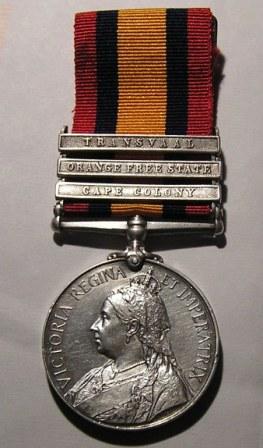
The medal in question is a Queen's South Africa Medal with the clasps Transvaal, Orange Free State and Cape Colony.  This medal was awarded for service during the Boer War.

The medal is named to 729 CPL W Oaks Victorian Mounted Rifles. However, it is immediate obvious that the original name has been erased and W. Oaks has been added. The number and unit are untouched. As can be seen in the pictures of the medal the rim is thinner near the W, the font is not the same as the unit name and close inspection shows that the renaming is done by chisel engraving where the rest is impressed. The final tell tale is the remnants of the previous naming to the right of the 'W'.


My mate Daryl is a QSA expert but between the two of us we just couldn't find a person by the name of Oaks who served in an Australian contingent to the Boer War. So we reverted to what was known: the number and the unit. This led me to 729 CPL Charles Edward Somerset O'Donnell. I'm convinced that this is the man who was originally awarded the medal. O'Donnell is also mentioned on the Australians in the Boer War data base and his photo appears as part of a contingent montage.
Source: T Humphrey & Co./Melbourne Leader 16.2.1901.

Usually medals are renamed for a number of reason, sometimes to deceive or to replace a medal in a group where the original has been lost. This got me thinking about why O'Donnell had either sold his medal or lost it. If it was sold it might have been due to financial hardship during the Depression which was a common occurrence.
While putting together the story about the O'Donnell the first piece of information I came across was the 1903 death of his sister. 
Source: The Argus (Melbourne, Vic. : 1848 - 1956), Monday 30 March 1903, page 1
(Clicking on the articles will produce a larger view)

The death notice confirmed O'Donnell's mother's name and it also gave me his father's name. This is where the story really took off. 
As I looked at the electoral rolls for Edward O'Donnell, his occupation was listed as either Gentleman or Independent Means. At the time this meant that the individual was wealthy and did need to work. How interesting I thought. If the O'Donnell's were a wealthy family what happened so that Charles might have had to sell his medal?
The next article I found concerned a court case where Frances (Charles' mother) was petitioning for Edward to pay for her financial upkeep while they were estranged. The estrangement was attributed to Charles being violent towards his father and his mother always standing up for Charles. 

Source: The Argus (Melbourne, Vic. : 1848 - 1956), Wednesday 29 August 1906, page 11


Edward had enough of Charles and moved out. The article details that the O'Donnell's owned several houses and that Edward was a retired Detective Sergeant. Edward and Frances must have later reconciled as they appear in the electoral rolls together for some years after this case. 
The information about Edward's profession then opened up more information. Trove is awash with articles about Edward who was one of the leading Victorian detectives from about 1865 through to the early 1900s. Many of the major crimes in Ballarat and Melbourne from that period were investigated and solved by Edward. 
All this previous publicity was inconsequential when compared to what happened on 27  July 1900.


Source: The Argus (Melbourne, Vic. : 1848 - 1956), Tuesday 31 July 1900, page 5

Many more articles followed this initial one and Edward's condition fluctuated over several months. The story unfolded over some time and it transpires that Edward had been led in to an ambush when he was shot. The story came to a conclusion when a career criminal was arrested in Perth in October 1900 and identified as the man responsible for shooting Edward.
Source: The Argus (Melbourne, Vic. : 1848 - 1956), Tuesday 16 October 1900, page 5

From what I could gleam from all these articles, Edward received a handsome pension and a substantial reward which allowed him to have Independent Means. However, it appears that the family fortune, as well as a large amount that Frances inherited, was lost over the years and Charles was left nothing.


18 November 2012

Mildred Evaline Vaughan


This is a fascinating story which I'll let Bill tell. 

'The Vaughan story began when I was approached by the President of a Melbourne RSL Sub-Branch. The Club had been given a collection of medals, the result of a collector deciding to pursue another hobby. The President, while willing to accept the medals, felt that there should an examination into how the medals came to be sold in the first, and so the story began.
Invariably when we ring a next of kin of the recipient of the medals we hold, and after having explained who and what we are doing, we are most often met with the comments "Dad's medals. They have been missing for years. Where did you find them?"
It is not unusual that as we pass through our research, we swing backwards and forwards, where we sometimes think we have taken not the expected two steps back, but rather we are back again at the beginning of our search. Often trying to work out how we got it wrong by proceeding down one path, when you probably should have ignored it altogether.
But never, until I started the search for the family of VF510178 Mildred Evaline Vaughan had I been met when calling with the words "What medals? Mum didn't have medals. Dad yes, but Mum no". Then the second question; "Where did you get them? The answer to that question is usually short, but the answer to; "How did you find me?" is the one that takes up the time.
So then came the first part of the answer explanation that Mildred had served during WW2 in the Army, and as such she was eligible for the War Medal and the Australian Service Medal 1939-1945.
 The second part was a bit more complicated. Several years ago a medal collector tiring of collecting medals and having lost the enthusiasm for his hobby faced with the problems associated with selling his collection, gave them to a Melbourne RSL. An incoming President asked me if it would be possible to do an audit of the medals, in particular their background and where had they come from.
Perhaps the most pleasing part of the search was for it to end with a successful conclusion. A search that was began in March 2010 was completed this week when Mildred's medals were presented to her daughter Jane.


Mildred's family had a tradition of Military Service, her father Lieutenant Percy William Vaughan, served with the 1st Australian Service Squadron in South Africa during the Boer War from 1900 to 1901. During WW1 he was promoted to Lieutenant Colonel in charge of the defence of the Newcastle Port.


Lieutenant Percy William Vaughan 
Originally the Manager of City Bank, Braidwood, NSW, Percy received 5 bars to his Queen's South Africa Medal and was Mentioned in Despatches.
His son Kenneth Montague Vaughan served as a Captain during WW2.
His other daughter, Phyllis, married a Royal Naval Commander.
So it was in this tradition that Mildred joined the Army during WW2.
As for the search itself, well it took the assistance of the team at the Australian Surname Group and many many hours in the State library of Victoria, carefully trolling over old newspapers and electoral rolls. I followed the progress from Melbourne to Perth where Mildred met and married William Hudson in 1946. Mildred returned to Melbourne to live after the death of her husband. 
But the question does remain where have the medals been all this time? And who had them court mounted. As I explained to Jane, I don't know and I guess we probably never will, but what is more important is that the medals are home with Mildred's family.'
The returned medal tally is now 1202.

10 April 2012

Queen's South Africa Medal and British War Medal

This pair of medals is quite an unusual combination. The first one is the Queen's South Africa (QSA) Medal awarded for service during the Boer War. The QSA covered the period 1899 to 1902 and then the King's South Africa Medal was awarded after 1 January 1902 as Edward VII had come to the throne.
The QSA of this pair was awarded to 170 George Hamilton Sydney Maddock. George served with the 4th Contingent of the Queensland Imperial Bushmen. The clasps with the medal are for Transvaal, Orange Free State and Cape Colony. The Australian War Memorial Boer War nominal roll indicates that George was also with the 6th contingent. The QSA is named to the Queensland MR (Mounted Rifles). George's brother Arthur also served with the 7th Battalion of the Australian Commonwealth Horse.
George enlisted to the 11th Australian Light Horse for WWI. This link is to his service record. (To access the service record follow the steps in this tutorial.) He was later allocated to the Imperial Camel Corps. His British War Medal is named to the Camel Corps which makes the pair of medals unusual. The BWM is his only entitlement from WWI and this is confirmed in a series of letters in his service record.
George was from a rather large family, he married and had one son. All of his siblings who survived past childhood also married and had children but the family has been difficult to find. George and his brother Arthur married the Queale sisters but all of the close subsequent generations have died out. George's son and Arthur's three sons all served during WWII with one being a POW. However, none had children of their own.
I have found a relative who has considerable family history material for the Maddock family and I'll return the medal to her. Thanks to Rod S who forwarded the medals to me and to Catherine who wanted the medals returned in the first place.
The returned medal tally is now 1118.
The QSA:


 The BWM: