31 May 2014

The full story of the three medal groups to one family

This is the full story of the medals that I previously posted under the heading of Three Medals Groups to One Family. The tale is now continued by Bill:

One of the enduring relationships that we have formed is with the RSL and Australia Post. It was from these two organisations that this search originated. As long term readers will know that when the take on some cases from statutory bodies there or often details that we are unable to publish. Therefore, I ask that you excuse any gaps you might perceive and use your imagination.
Like many searches involving the Victorian RSL this one started with a call and follow up email from Jude Beshears from Anzac House in Melbourne. She had several sets of medal to for me to research. A call and email, this was unusual and really piqued my interest. A further call from Elizabeth Manning, also of the RSL, and the accompanying comment that one medal has the word 'For Bravery in the Field' on it really got my attention. So much so that I broke a long held rule that I don't drive in to the city. Well I did and have now determined that I'll invest in a parking garage rather than a house.
What a collection of medals I was presented with on arrival and I now realise why Jude and Elizabeth wanted to call me personally.
The medal groups were those to:
797 PTE Alfred Hampton Carr, 5th Machine Gun Battalion and comprised the Military Medal, the British War Medal and the Victory Medal.
2050 PTE Robert Alexander Carling, 39th Battalion comprising the British War Medal and the Victory Medal.
418801 LAC Charles Ernest Carling comprising the 1939-45 Star, the Pacific Star, the War Medal and the Australian Service Medal 1935-49.
My immediate reaction was to link the Carling medals as most likely that of father and son. The Carr medals didn't immediately appear to be linked but as they were all found together they may have been.
In many ways my searches begin with a simple well laid down process. One I've had described to me as boring, but it works and I think the simplicity stops me jumping to any conclusions that would later lead me astray. This process sees me go through the records available through the AWM and the Australian National Archives. I quietly read these and try to establish a family tree. I then move on to War Graves to establish a date of death. Then it is a cemetery search which might lead me down the road to knowing which funeral director conducted the burial. If this is the case I might get lucky and the funeral home is willing to contact the family. Then, as I've said before, I might resort to sheer desperation and spend long hours at the Victorian State Library.
In this case I could easily confirm the Carling medals were from the same family but Carr drew a blank. The Carlings were from Victoria but Carr was from South Australia and the paucity of information in the South Australian Records frustrated me.
So I began working backwards from who I thought was the youngest being Charles. While I found his grave many of the other records associated with his death and burial were no longer available.
So it was back to my simple process to trawl through the electoral rolls, Trove and the last option of the State Library. A combination of these three and a bit of luck, well a lot of luck, and some back ground information from the original recovery, that lead me to Charles' widow, Norma. 
It was Norma who, between pauses to blow her nose, provided the key information that bought together the beginning and conclusion of this search. Later the same day I spoke to Norma's daughter, Leslie, to arrange the return of the medals. Like Norma, Leslie was also blowing her nose. The reason given was that they both had a cold and I think I'll let them stick to that story.
When I spoke to Norma and Leslie I got the full story about the medals. Robert Albert Carling was the grandfather of Charles Ernest Carling. Alfred Hampton Carr was Robert's nephew making him Charles' uncle.
Norma also told me that she was burgled 9 months ago. Indeed, Norma disturbed the burglars who fled with the medals, her jewelry and some family papers. Other items like her laptop and TV had been made ready to go. The police offered little hope for the recover of any item but after the papers were left n her letterbox she held out hope that just maybe the medals would be recovered.
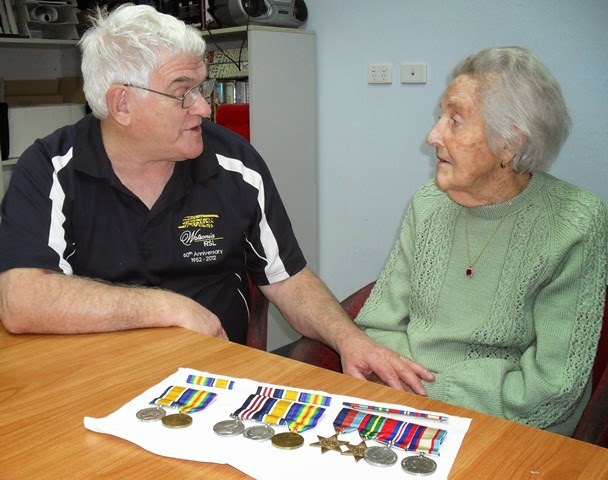
The photos show the medals Alfred Carr, the citation for his MM and the ladies and Bill discussing the medals.


29 May 2014

Contemporary ADF pair

I'm often asked where the medals that are donated to me come from. I half joke that some fall of a soldier's jacket on Anzac Day. That is exactly what happened to this pair awarded to a serving member of the Army Reserve. The medals are the Defence Long Service Medal with three clasps (signifying over 30 years service) and the Australian Defence Medal.
The medals were found by the grandchildren of Ted H who contacted me to return the medals. With the assistance of my colleague, Roland T, I was able to locate MAJ Smith and the medals will be sent home in the near future.
The returned medal tally is now 1457.

26 May 2014

RAAF WWII War Medal

The WWII War Medal awarded to Leading Aircraftman Victor Raymond Couchman is one of two medals he was awarded for his service in the RAAF. This medal was sent to me by my friend Sandra. I now know that the Australian Service Medal 1939-45 awarded to Couchman is still with the family so the full entitlement is now reunited.
Thank you Sandra, you will be pleased to know that this search took 18 minutes from start to finish (sorry Bill). The returned medal tally is now 1455.

25 May 2014

Light Horse Regiment medal

This story has two parts that are about a decade apart.
I first returned the 1914-15 Star and British War Medal to the family of 804 T-CPL Elias Huxtable well before I had a website or blog. I didn't have a PC then either and all my records were hand written. Fast forward to last week when I received an email from the original donor telling me he had the Victory medal to Huxtable as well. I then had to dive in to some old storage boxes and locate the copies of my original research. Once I found it I was able to contact then again and pass on this piece of news.
Huxtable was a member of the 10th Light Horse Regiment. His service record is only 11 pages long and the most interesting bit is the fact he was Court Martialed for prejudicial behaviour and awarded 40 days field punishment. The Court Martial documents haven't yet been digitised so it isn't know what the prejudicial behaviour actually was.
10th Light Horse Regiment is still in existence and a unit which I have a close link to.
Thanks to Stuie for sending me these medals. The returned medal tally is now 1454.


24 May 2014

Three medal groups to one family

There is not much that we can actually tell about this story. What I can say is that nine medals, one being the Military Medal, to three generations of the same family will soon be returned. Bill did a fantastic job putting all the pieces together.
The returned medal tally is now 1453.

17 May 2014

James Barnett

I received the WWI Victory Medal awarded to 1678 PTE James Absalom Barnett last July from Nathan D. James served in the 45th Battalion, AIF. He was also awarded the British War Medal.
It was rather easy to follow James' life but the next step to any living descendants alluded me.
In recent months our fellow researcher Alex L has been able to dedicate some more of his valuable time to me. He had a fresh look at this case and quickly found records for James' daughter and then on to her son Jon.
This morning I spoke to the family and will be returning the medal shortly. Many thanks go to Nathan and congratulations to Alex who tells me he 'is happy to be back on the scoreboard'.
The returned medal tally is now 1444.

15 May 2014

Australian Defence Medal

Another medal that I received yesterday from the WA RSL was the Australian Defence Medal awarded to M Landrigan.
I surmised that the number was for a member of the RAN as it was obviously part of the first PMKeyS issue. A search on the internal Defence network yielded no results by a person by the same name came up in an old copy of Navy News. The story was about safety measures implemented by this sailor. A Google search of the surname and safety lead me to a LinkedIn profile. This in turn gave me the current employer who I called and not long after I was speaking to Matt. All up the search took about 30 minutes (sorry again Bill).
The returned medal tally is now 1443.


03 May 2014

Leslie De Vis

The De Vis family was a rather typical one in the late 19th century in Australia. It was a large family and some of the children died in infancy. The family was from North Queensland and the children were either born in Charters Towers, Townsville or Bowen. The British War Medal I was given by Karyn H was awarded to 2455 PTE Leslie Holmes De Vis. The medal is named to his first unit, 1st Bn AIF however, he was later transferred to 42nd Bn AIF. De Vis was killed in action on 18 October 1917.
With such a distinctive surname I thought that the search for this family would be reasonably. However, through the records there are different spellings of the name. Variations I came across include Devis, De-Vis, de Vis and even Deuis which is also how the medal is named.
What I did discover was that of all the children of this large family, five enlisted for WWI. They were:
LT Charles Edwin De Vis MM,
PTE Frederick Selwyn De Vis,
PTE Herbert Walter De Vis, and
Sister Gertrude Julia De Vis.
Charles and Frederick would also serve during WWII.
Of all Leslie's siblings, I could only determine that Gertrude, Frederick and William had children. I couldn't track down Gertrude's children.
Frederick's only son, Selwyn George De Vis served in the RAAF and was killed in action during a bombing mission over Germany on 19 March 1945. Frederick De Vis was a Commonwealth public servant and lived in Canberra for many years. Selwyn worked for the CSIRO before enlisting. This link to the ACT Memorial page gives a synopsis of Selwyn's life.
The only other of Leslie's siblings I could find who had any children was William. In the 1930s William was a miner in the WA gold fields. I lost track of him through the official records but I found a William De Vis buried in Rockingham, WA. I quick search of the White Pages showed that two families with this surname lived in that area. I took a punt and cold called one of the numbers.
The punt paid off and I ended up speaking to William's grand son. To my very pleasant surprise I was told that William's son, Leslie's nephew was still alive. We have since spoken and the family military history is well known and documented in the family.
Thanks to Karyn and Rob for giving me the medal. The returned medal tally is now 1439.

Post update 2 Jun 14
In the last week I have been contacted by William De Vis' daughter, Margo. She has kindly provided me a composite photo of all the the De Vis siblings who served during WWI.
  Backrow: Bert and Fred Front row: Les, Gertrude, Charles.

26 April 2014

Repost - Duplicate, Replacement, Replica and Copy Medals

There has been a huge spike in the number of hits I've had for my blog post about Duplicate, Replacement, Replica and Copy Medals. I suppose that this is unsurprising around Anzac Day and people's interest in what has happened to family medals that are no longer with them. I also suspect that now that we are on the eve on the Centenary of Anzac there is additional interest.
So I'll bump up the link to the Duplicate, Replacement, Replica and Copy Medals post so it is easy to find.

19 April 2014

John Jamison 3rd Light Horse Regiment

For the first few years after I started this endeavour, I would let people looking to return them keep the medal while I got on with the research. Unfortunately, on several occasions after having found a family, I discovered that the person with the medal had changed their mind, had given the medal away or sold it. This left the family confused and angry and my reputation in question. I had also invested many hours of research and often paid for documents from different archives. Bill and I decided that we wouldn't conduct any research unless we had the medal first.
When I'm contacted by a donor I now explain that I won't conduct any research without the medal.  In most cases this is an acceptable arrangement and I also commit to advising the donor of the outcome. The odd person would prefer not to send me the medal and do their own research. However, every now and then a set of circumstances arises which makes me disregard this policy altogether.
I was recent contacted by Frank of South Australia. Frank had the Victory Medal awarded to 1025 Trooper John Jamison. John was a member of the 3rd Light Horse Regiment, he died of disease and is buried in the Cairo War Cemetery.
John was from a large family, however, through death at infancy or the consequences of WWI only one of his siblings had a child of their own. Several of John's siblings were close to Frank's family and many years ago they gave him John's medal as there was no member of the Jamison family to pass it to. Based on this I thought it completely appropriate for Frank to retain the medal while I got on with the research.
Thanks to some assistance from a SA genealogy group I'm a member of on Face Book I was able to piece together John's family tree. As I mentioned, one of his sisters did marry and have her own daughter but she had no children of her own. That line of the Jamison family ran out.
I then went back and looked at John's father's siblings. John's father's name was Frank. Through funeral notices of the Adelaide papers I found that Frank was the son of Frank and 'Granny' Jamison. Frank senior was the second husband of 'Granny'. She was actually Elizabeth Sivor and her first husband was Richard Harrowfield. Elizabeth and Richard had a couple of sons, one being James Nash Harrowfield. This is Trooper Jamison's uncle. I followed this line through to the current generation and today I spoke to a member of the Harrowfield family. I've connected them with Frank and I'm sure that in the near future the medal will be returned to the family.
The returned medal tally is now 1438.

27 March 2014

Samuel Cryer

This pair of WWI medals was sent to me by the WA RSL. They were awarded to 21904 Samuel Cryer. Samuel served in the Border Regiment but the details I had on him were rather thin. After revisiting this search on several occasions I found Samuel included on the Ancestry family tree of Teresa F.
After I contacted Teresa she passed my details to Samuel's grand daughter who has recently been in contact with me. I'll be sending these medal back to the family in the near future.
The returned medal tally is now 1437 (there has been another return in recent days which I'm unable to publish the details about).

20 March 2014

William Lord

This medal was also sent to me by Garry J who sent me the WWII War Medal awarded to 254982 Douglas Yule Thomson.  It is a WWI British War Medals awarded to 4529 William Edward Lord, 9th BN AIF.  Once again, thanks to Ancestry.com.au, I quickly found William on a family tree. I fired off a message and I have now been in contact with William's grand daughter, Anne. I'll arrange to send her the medal in the near future.
Thanks once again to Garry. The returned medal tally is now 1433.

18 March 2014

Another quiet return

Every so often I receive a request from a Police force asking to research some medals they have come across. The circumstances usually involve a theft and sometimes there is some need for some prudence with the details. Last week I received a request from the WA Police about just such a discovery. Based on the name, which was a we known Perth family, I was able to point the police in the direct of the veterans son.
Today I was informed that the family has been contacted and the medals will soon be returned.
The returned medal tally is now 1432.

17 March 2014

Douglas Thomson

This is a very short post, a little like the amount of research that when in to it.
Last week I received the WWII War Medal awarded to 254982 Douglas Yule Thomson from Garry J. As soon as I saw the hand engraved naming I know it was a RAAF issue.
Yesterday I got down to doing some research and within seconds of starting I had, via Ancestry.com.au, a lead on Donald's family. Within a minute I had sent a message to the tree owner and today I received a response from Donald's son David. I'll arrange to send him the medal in the near future.
Thanks go to Garry. The returned medal tally is now 1427.
The photo shows hand engraving which is typical for RAAF WWII medals.

09 March 2014

Samuel James Steele - case closed

This particular search started when I received an email from Major Dan H. Dan had a 1914-15 Star awarded to 2248 PTE Samuel James Steele. When the medal arrived I was immediately intrigued by the unit that Steele was posted to - the 2nd Remount Unit. I knew what this type of unit did but I'd had not seen a medal to this unit before. The AIF remount units received, prepared and forwarded horses to light horse units fighting in Palestine. Steele's service record gave me several clues about him including his wife's name, his place and year of birth and some correspondence in the 1940s with his address. Usually this amount of information is sufficient to provide a clear linage to the current generation.
In this case I was totally wrong. Each lead in the service record yielded nothing. There was also a large discrepancy between the place of birth listed on the WWI enlistment papers and what was later stated in a Salutatory Declaration. The usual sources that I access gave me no new leads, I really hit a brick wall. I couldn't move forward so I looked backwards.
Steele's WWI record mentioned in two locations that he had served in the Boer War. This was the first real break through and the following story unfolded.


Mention of the Boer War battle at Wilmansrust may spark little or no recognition these days. Several articles have been written about this action in recent years; however, the event seems destined to fade into Australian Military History largely unremembered. Taking into consideration that the battle itself was more obscure than many others in which Australians have fought, this is perhaps not surprising, but the subsequent scandal following the event is worthy of recognition. This scandal had a significant impact on decisions that were later made concerning the fledgling Australian federation’s military force.
I stumbled upon the name Wilmansrust quite by accident as a result of the brief mention that Steele served during the Boer War. Subsequent research unearthed the story of the Wilmansrust battle, the subsequent scandal and 1142 Private James Steele’s role tumbled out.
It took a while to confirm, however, it is certain that 2248 Private Samuel James Steele and 1142 Private James Steele are the same man. That was the second significant piece of research that went in to this story. This is a picture of Steele published at the time he departed for the Boer War.

The Battle at Wilmansrust.
The 5th Victorian Mounted Rifles (5th VMR) arrived in South Africa in February of the year 1901 with a compliment of 46 officers, 971 other ranks, and 1099 horses. By June of that year, the regiment, now numbering around 700 men, was allocated to a column under the command of Major General S.B. Beatson, a British officer. The regiment was split in to two wings. Major Umphelby commanded the right wing. Major McKnight commanded the left wing. McKnight was allocated two small artillery pieces under the command of a British artillery officer by the name of Major Morris. Although Major McKnight was the senior Victorian officer of his wing, he answered to Major Morris.
Major McKnight’s wing was tasked to sweep towards a reported Boer encampment that they found to be abandoned. The left wing then commenced its return to the main column but by the afternoon of 12 Jun 1901, with Major McKnight and his men approximately 20km from the main column, Major Morris ordered a halt, and for the men to make camp near Wilmansrust farm. To provide security, Major Morris, who was in charge, set pickets. At the camp proper the men centralised their weapons away from their tents as ordered, and slept prior to being required for duty. The on duty pickets numbered 120 of the total force of 350; furthermore, each picket was some distance apart and was not supported by a patrolling program or a communication system. Unfortunately, this was also observed by the Boers.
After the 5th VMR camp settled down, the Boer Commandant Muller led a group of commandos between the pickets and on into the camp. The time was 1930. The Boer numbers are reported to have been between 120 and 170. During the assault it has been noted that the Boer commandos spoke in English and were dressed in khaki, which added significantly to the confusion. Majors McKnight and Morris were captured, the outer pickets did not assist and within 15 minutes the battle was over leaving 18 men from the 5th VMR killed and 41 wounded. The Boers departed with the artillery pieces, horses, ammunition and other supplies. After having walked a short way with the captured officers the Boers released them when they realised they had no way to hold them.
Major General Beatson held the 5th VMR completely responsible for this disaster. Shortly after the battle he came across some members of the regiment who were bayoneting a pig and is quoted as saying, ‘Yes, that’s just about what you men are good for. When the Dutchmen came along the other night you didn’t fix bayonets and charge them, but you go for something that can’t hit back.’
Following this, a further insult against the 5th VMR was again made by Major General Beatson, this time in the presence of two Australian Officers, Major Harris and Captain Anderson. It is reported that Beatson said, ‘I tell you what I think; the Australians are a fat, round shouldered, useless lot of wasters.’ Harris remonstrated with Beatson and declared he would note the General’s comment. Beatson responded, ‘Do by all means, and you can add if you like that in my opinion they are a lot of white-livered cur….You can add dogs too’.
The Mutiny.
 In July, the 5th VMR was again allocated to be under Beatson’s command. This caused much discussion amongst the soldiers. One was overheard to say, ‘We’ll be a lot of fools if we go out with him again. It will be better for the men to be shot than to go out with a man who called them white livered curs’. The man accused of making this statement was Steele, who was quickly arrested with the two other men present, Privates Arthur Richards and Herbert Parry.
The sentence.
The three were very quickly court martialled for mutiny and on 11 July 1901 were found guilty and sentenced to death. Lord Kitchener quickly commuted the sentences to prison terms with hard labour. Steele received ten years, and Richards and Parry received one year each.
An inquiry was also held into the decisions of Major Morris at the battle. Due to his overall command status at Wilmansrust, the Morris was censured.
Parliament.
The Australian press was soon reporting the story and there was considerable public outcry, leading to it being reprinted in papers all across the country as well as in New Zealand.  The matter was soon brought before the new Parliament and the Prime Minister Sir Edmund Barton, who then petitioned King Edward VII as the prisoners were by then in England. The King intervened and secured the prisoners’ release and return to South Africa and then home to Victoria. The British Judge Advocate General later quashed the convictions
Letter to brother-in-law.
Amongst all the articles published about Steele was a letter which he wrote to his brother-in-law from prison. This provided proof that Steele had a wider family than just his wife, though unfortunately the brother-in-law’s name is not given.
At the end of this story I've included several of the news paper stories and a published version of this letter that appeared in the papers at the time.
Aftermath.
The ‘Wilmansrust Scandal’, as it became known, had a considerable impact on public opinion in Australia, though it was later overshadowed by the Breaker Morant execution early in 1902. The more recent popularity of the Morant story has probably assisted in pushing the Wilmansrust episode further into the shadows. That being said, the treatment of Steele, Richards and Parry probably played a bigger part than the Morant case did in shaping Australia’s laws concerning Australian soldiers being subject to capital punishment.
This policy to retain disciplinary control by Australian authorities during WWI rather than allow Imperial discipline to occur, was a significant decision for the new Commonwealth. It may also have played a role in the larrikin attitude of Australian soldiers during WWI, knowing that the death penalty would not be applied to them.
News paper report.
Steele appears in the newspapers again other than in the stories about Wilmansrust, as having assaulted a policeman in 1902 in Deniliquin. He served 6 months hard labour. This is his prison photo.
WWI.
Samuel James Steele next appears in official documentation at his enlistment, aged 46, for service during WWI. Steele’s service record shows that he was living in Queensland when he enlisted, and that his wife’s name was Jessie. While the enlistment attestation paper mentions his Boer War service there is no specific mention of Wilmansrust.
Steele made it to the theater of war in late 1915, which made him eligible for the 1914-15 Star. He was also awarded the British war Medal and the Victory Medal. Steele returned to Australia and was discharged in Brisbane.His service record shows that disciplinary action was taken on several occasions and were related to alcohol use.
There is no evidence of him on the electoral rolls, nor on any of the ‘births, deaths and marriages’ rolls in either Queensland or Victoria. A letter from 1943 that appears in his service record shows that he was living in Melbourne at the time, but after that there are no further records on him.

So, despite all this information I was really getting no where. Following the success of the McCarthy story I contacted Jennifer King from ABC to see if she would be interested in another story. The end result was this online edition.
The story generated considerable interest. I had hoped that a relative would read it and come forward. No such luck. What I did get were emails from several people each of who had a small piece of information. It took me about a fortnight to piece everything together but I eventuality work out a family tree.
Samuel James Steele was the son of James (John) Steele and Elizabeth Conway. The family was from Ballarat. I think that the place on birth that Samuel James gave on his WWI papers was a ruse. This town was Korumburra and on the opposite side of Victoria to Ballarat. One of Samuel James' sisters married in to a family from there so I think it was adopted as the place of birth. John died in 1887 and this is his head stone.
One of Samuel James' sisters married Walter Blews from Korumburra and it is Walter who is the brother in law that Samuel James wrote to from prison. Another sister, Elizabeth married Albert Alway and it is this branch of the family that I was able to follow. I got as far as the current generation but once again I went back wards in this search.
The one constant piece of information that I had for his family is that from about 1900 they lived at an address in Camberwell. It kept cropping up in the electoral rolls. I was eventually put in touch Elizabeth's grand daughter, Jean, who is alive and well aged 90. Jean only sold the Camberwell home 4 months ago to move in to a retirement village. Jean was able to confirm all my research and add a bit more. It would appear that Samuel James was referred to a Jim and he and Jessie weren't actually married but lived together for many years. Jim was living in the Camberwell house at one point when Jean was a toddler which is an amazing link with this research. Jean is Samuel James' great niece.
I'll be sending the medal to Jean in the near future. I've individual thanked all the people who were able to assist me with this search, however, I would like to single out Jen King for her assistance. The extent this body of work is also one of the reasons that there has not been many other stories posted in recent weeks. The returned medal tally is 1426.


27 February 2014

Some stories just can't be told

Over the years I've returned some medals that for one reason or another I haven't posted any details. The reason are a little varied but generally revolve around a desire by the donor or the family not to be identified. Every now and the the story about the soldier is one where discretion needs to be maintained. I've had three such cases in the last couple of weeks and I have chosen not to publish any details out of respect to one or more of the parties involved.
I hope readers understand these circumstances.
The returned medal tally is now 1425.

24 February 2014

David Frederick Hart

This search commenced in October 2013 when the WWII War Medal awarded to S42465 Dave Frederick Hart was sent to me via my friend Sandra. Hart was from South Australia and as most family history researchers know, the available records from SA are a little thin compared to other states. I did find that Hart had three children but other than their first names I had no other information.
I recently found mention of Hart on an Ancestry family tree from Chris C. Chris had contacted a distant relative and was able to provide me the married names and spouse's names of all Hart's children. Armed with the initial of Hart's son and his wife I found a similar entry in the White Pages so I took a punt and gave the number a call. Sure enough I had the right family.
Thanks go to Sandra and Chris. The medal will be on its way to David Hart's son in the near future.
The returned medal tally is now 1417.

23 February 2014

Samuel James Steele update

The Steele research is resolved. It is quite complicated so I'll have to spend some time writing it up and consulting with ABC about a follow on story.

17 February 2014

The search for the family of Samuel James Steele

This is a link to my latest collaboration with ABC Online about Samuel James Steele.

16 February 2014

Fred Hayes

S8355 Able Seaman Fred Hayes served in the RAN during WWII. He married a little later in life and didn't have any children with his wife Daphne. It is though Daphne's family that I've located a family member who I'll send the medal to in the near future.
Thank you to Anna G who pointed me in the right direction and to Bob GG who provided me with some additional information and to whom I'll send the medal. This medal was originally sent to me by the Dee Why RSL.
The returned medal tally is now 1416.

13 February 2014

Joseph Miller

This has been another difficult search for several reason.
After I received the medals from the NSW RSL, via the Wauchope Sub Branch, I found there was something not quite right. The medals are named to WX731 J. Miller. However, this number was allocated to Cecil Fitzgerald. A bit of effort revealed that our man was actually VX731 Joseph Miller. I have seen mistakes on medals before but they are not common and usually the veteran will return them for correction.
Once I sorted out who was who the long task of finding a family member started. This then proved to be the second and more difficult hurdle. Bill and I enlisted the Australian Surname Group but all the leads were dry holes.
That was until today when I received a surprise email from Laurie who is Miller's nephew. He had come across listing on the web and got in touch. Another nice addition to this group is that Miller was Mentioned in Dispatches
The returned medal tally is now 1415. The pace is picking up a bit.


12 February 2014

Arthur Smith

The first thing I found out about 60474 Flight Lieutenant Arthur Leonard Manning Smith was that he died of disease in 1946. This information led me to an entry on the Australian War Memorial site and also the RAAF casualty data base. This last link held a surprise by including a photo of Smith's headstone which I've added below.
The next step was to look for the WWII service record which I found on the NAA website. This record makes interesting reading and surprisingly a photo of Smith (on the first page of the record).
Smith's NOK was listed as his father so there was no wife or children to look for. As far as I could work out he was an only child so back I went through his parents families. His mother's maiden name was Sevenoaks which made the search a little easier. This lead me down the line of Smith's uncle. Today I spoke to Smith's second cousin and will send the medals to Eva in the near future.
The medal is one which I don't see to often it is the France and Germany Star primary awarded to
aircrew.
Thanks go to Vicki D who sent me this and medals to three other soldiers.
The returned medals tally is now 1410.


09 February 2014

PTE Samuel Yeardley MM

Things have been a little quite recently so I have been busy reviewing old cases. Today I pulled out the card of Private Samuel Yeardley who I first wrote about 4 years ago. This is what I posted at the time:

I recently received a Queens South Africa Medal awarded to PTE S.Yeardley Cape Medical Staff Corps. I decided to put up a post now rather than wait until the search is resolved as the medal is not one I usually deal with and putting Yeardley's name out on the Internet might pull in some more clues.
Through the British Medal Forum I was provided a link to the Boer War nominal roll that has Yeardley's name although spelt Yardley. I also found the original of this list. Unfortunately neither gave me a clue as to where Yeardley came from. I took a punt and searched the AIF data base and got a hit. I got a bit excited when I saw he was an MM winner but nothing linked the S. Yeardley of the Boer War to the S. Yeardley of WWI. So off I went to the Australian Archives and found this record. On the first page was a clue that they might be the same fellow. In answer to the question about previous military service there is the comment; '12 months 21th Field Hospital Anglo Boer War'. This is by no means conclusive but a very strong link.
Making the assumption that they are the same fellow I started searching the NSW BDM as WWI Yeardley was discharged in 2 MD (NSW). Given the clues from the service record I located some details for Samuel Yeardley who married Doris Parr in 1924 and died in 1961. Doris was born in 1891 and died in 1978.
Bill posted all this on Australian Surname Group and they have found some great information. I'm sure that it wont be long until a relative of Yeardley is found and in the mean time here are some pictures of his QSA.

Well my last sentence proved to be completely wrong.

Having exhausted the all the clues linking Doris to any close relatives I had to move further afield. Doris was the daughter of Samuel Herbert Parr and Elizabeth Mary. Doris had four siblings who either didn't marry or died young. This then led me to the siblings of Samuel Herbert Parr. One of which was John Fillingham Parr. John married Elizabeth Dennis and they had three children; Thomas Leslie, Ada Millicent and Stanley Guy. Thomas died having not married and I can not find any about Ada other then the record of her birth. I now know that Ada didn't marry. So the next line of inquiry was through Stanley, Doris' first cousin.
Stanley Parr married Katie Margret Carrington Hardcastle. They didn't have any children Kaite was one of 9 children, four died as children, four didn't have any children, however, one sibling had one son, John.
John is a WWII veteran and now in his 90s. I spoke to him today and he as very clear memories of Stanley. Even though he is a distant relation by marriage to Samuel he has kindly agreed to become the custodian of Samuel's medal.
Thank you to Henry C who sent me the medal on 16 Feb 10. Afteralmost 4 years this search is finally over.
The returned medal tally is now 1409.


08 January 2014

Mark Tuite

This Victory medal awarded to 2nd LT Mark Alan Wallace Tuite is one of the few we have remaining from the NSW RSL box. Quite quickly I located the details about Tuite's death on 2 Dec 1917. However, it was the rather tangled family tree complicated by numerous deaths during WWI that made this search difficult..
Tuite was from an aristocratic family with many senior officers amongst them. His great grand father was the 9th Baronet of Sonagh. The Baronetcy has now passed down the line of his great uncle. In that branch alone there was a Major General and many who served as subalterns. Mark's father was a naval officer, his uncle (10th Baronet) was a Colonel and his cousin a Lieutenant Colonel whose body was never found. As part of my search for a close family member I have received some great information from a distant relative. This is a summary of the information I have received:
1. 1911 Census. Mark, born Hampstead, was working as a journalist and living with father Henry, mother Marion and sister Honor at 45 Croxted Road. Father, Henry, was employed as an etcher, probably of photos since he was a photo engineer in 1901 and a portrait artist in 1891.
2. Messines & Third Ypres. Extracts from Landships-British Tank accounts of the First World War - sites.google.com/site/landships
Messines. 7 June 1917
6 Company. B Battalion with 25th and 36th Divisions, and the II ANZAC Corps (H2), 2nd Army
9 Section - Capt. Croxford
B41 2035   2Lt Tuite
Account of Operations - 9 Section: Three tanks reached their objective to find the infantry (H2), who had started earlier than intended, already there. B41 (2035) reached O27c at 9am engaged a battery at 250 yards range and thus enabled the infantry (H2) to capture it then returned to the RP. The Battalion history states that three tanks reached their objective and helped mop up. The battle graph indicates only B41 (2035) fired on the enemy.
Third Ypres. 31 July 1917
6 Company, B Battalion, with II Corps, 5th Army
9  Section - Lt AC Harcourt
B41 2035  “Boomerang”  2Lt MAW Tuite
Account of Operations - 9 Section: Three tanks proceeded to the junction just east of Clapham Junction where they found the infantry held up by MG fire from Glencourse Wood and Inverness copse. B41 (2035) engaged an enemy MG but became ditched south of the Menin Road. They engaged the enemy who were counter attacking towards Chateau Wood. B41 (2035) successfully unditched using its unditching gear but was unable to get up the Bank onto the Menin Road.  
3. LT Harcourts's DSO. 'On November 30, in the attack to capture Gouzeaucourt, this officer led his section of tanks into action. When one of his section commanders, 2nd LT Tuiet, was wounded, this officer, borrowed a horse and rode back for a stretcher, which he then took back under shell fire' Harcourt survived the war and went on to command 2nd Royal Tank Regiments in North Africia in 1940/41. He died in 1946
4.  Mark's Cousins. Lt-Col Henry Mark Tuite was wounded in command of the rearguard action when Vauix-Vraucourt was lost on 24 March 1918. His body was never found and he has no known grave. Lt Brian Hugh Morgan Tuite survived the war but a gunshot wound to his left arm, 9 October 1916, necessitated an emergency partial amputation in France followed by a secondary amputation in England.
Mark is one of 22 relatives who perished in WW1 that I'm researching via Google. I add the retrieved information to my family tree on 'ancestry' in hope that the site is available long after I'm gone. 
Thanks to JP for all this great information and to Simon from the British Medal Forum for his assistance. I'm now contacted the most appropriate branch of the family to receive the medal. This Victory Medal is in almost as issued condition and how it got to Australia is a mystery.
The returned medal tally is now 1408.


William Dyce

This search was a little complicated because of the soldier taking his step father's name but keeping his own surname as well. Once I had sorted that out it became a bit easier to located details about William Irvine Dyce.
William was 19 when he was killed in action at Gallipoli. Luckily, this bio provided a wealth of information about William's wider family. The bio also contained a photo which I've added below. William's brother didn't survive for many years after WWI due to his own injuries so the immediate family line appeared to end. Using Ancestry.com there was no clues which indicated any family connection for me to chase down.
Knowing that William was from a small island community I took a punt and wrote to the local paper, The Orcadian, to see it I could locate any family members. Shortly after publication of this letter I received an email for the a great niece of William's on his mother's side. The medals will be sent to this family in the near future.
Thanks goes to Max of Geraldton who acted as the intermediary between donor family and me. The medals were originally obtained by another veteran with the sole purpose of returning them to the family. How they turned up in Australia is anyone's guess.
The returned medal tally is now 1407.


Cyril McCarthy - the final chapter

Regular readers will remember the story of Cyril McCarthy and his WWI dog tag that was recently found in a French field. This is the original story, update 1 and update 2.
This search came to a wonderful conclusion recently when I received the dog tag from Philippe in France and arrangements were put in place for me to meet Cyril's grand son Bernie and hand it back. ABC journalist Jennifer King wrote the original story that started this journey and has also been heavily involved in bring it to a close. This link has Jennifer's on line story and an embedded video of the TV news report.

02 January 2014

Alan Barcham

This is a very short story which does not do justice to the hours of research put in by Bill and Liz from the Australian Surname Group.
I received the Australian Service Medal 1939-45 awarded to NX72330 Alan Herbert Barcham from Heather K in January 2011. The suspender bar on the medal is missing which is how I suspect that the medal became separated from the rest of the group. Thanks to Liz's research, Bill was recently able to contact Alan's son and I'll return the medal to the family in the near future.
The returned medal tall y is now 1405.

19 December 2013

Michael James Fitzgerald

The resolution of this search came about after a number of small threads came together to present the full picture. A little bit of luck also went my way.
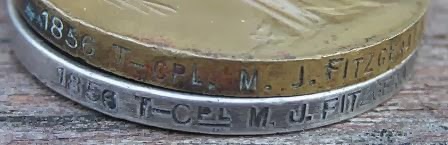
1856 T-CPL Michael James Fitzgerald originally enlisted with the 3rd Light Horse Regiment. His service record doesn't provide much detail about where he served but it would appear that he transferred to the field artillery as a driver and ended up in France.
I couldn't find any evidence that Fitzgerald married so my search extended to his siblings. After a false start in March this year I revisited the search yesterday. Fitzgerald was one of 13 children, one sister was Bridgett who married Reginald Roy Shanks. I found an interesting story about a deserter that Shanks was sent to arrest.
It is through Bridgett's family that I focused my research. Reginald and Bridgett son was Gerald who in turn had three children. As luck would have it I found a family tree which provided me the name of his daughter and who she married. This name is quite unusual and I could only find one similar on line. Taking a punt (yet again) I called this person and sure enough I had the right family. The lady I spoke to is Fitzgerald's great niece and I'll send her the medals in the near future.
Thanks goes to Ken Duncan who sent the medal to me originally.
The returned medal tally is now 1404.