27 April 2013

Francis Baldwin

One of the reasons we list all the medals I have is so that anyone who is researching a family name on line might stumble upon our site. This has probably happened about 20 times all up.
I had very little information on 129765 PTE Francis Baldwin, Machine Gun Corps. The only facts I had was that Francis was a British soldier, he was born in 1890 in Lancashire and his father's name was Richard. This information took considerable effort to find and I must thank the members of the British Medals Forum for their assistance. Not a lot to go on and in the 7 years since I've had this medal this is all I came up with.
Well, as a direct result of the ACA story, a viewer looked at our lost medals list and recognised Baldwin's name.
Michael is Baldwin's third cousin twice removed and with in seconds of us speaking we confirmed we were talking about the same soldier. I had suspected that Baldwin did not marry or have children. Michael was able to confirm this for me. I'll post Michael the medal in the near future.
Thank you to Tony K who sent the medal to me in 2006. Once again my sincere thanks to Brady Halls for doing the ACA story. The return is attributed to Brady. The returned medal tally is now 1271.


25 April 2013

A Current Affair

Tonight, the Channel Nine news show A Current Affair screened a story about Lost Medals Australia as part of an Anzac Day special. I am very grateful to ACA, Brady Halls and the crew for this exposure. We had a fantastic day filming last week and meeting Nick who received the WWI medals awarded to Arthur Barnes.
The ACA story is at this link.

Lieutenant John Cooper


A wonderful Anzac Day story from Bill.

Well we have found medals in boxes, tin trunks, in the roof of houses being renovated, sewing boxes, but the search for the next of kin of LT John Eugene Cooper set a new standard, and a new puzzle, as yet unanswered..
Here it started with a Baxter (Vic.) auto wreckers, where when the carpet was removed wreckers found the 1939-1945 War Medal of LT John Eugene Cooper, no other medals just the 1939-1945 War Medal. Not knowing what to do with it they approached Fred Wawrzil, the Secretary of the Euroa RSL.
Fred immediately started to look for LT Cooper, or at least his NOK, unfortunately by the time the medal came to Fred the car had been demolished, and any records lost as to its origins, however not to be put off he hit the phone, and as he tells it he believes he rang every Cooper in the Frankston, Baxter region, currently dreading the next phone bill all he can report is that there are a lot of Coopers in the phone book but to none seemed to be the one he wanted.
Finally after contacting the Victorian Branch HQ of the RSL he ended up with me, and the next phase of the search began.
It was amazing at first how much I was able to find via TROVE about John Cooper, who was not only an accomplished musician, as was his wife they played concerts all over Australia, but was one of Australia’s foremost Physiotherapists, who treated the wounded in New Guinea during World War two, and later after the war he became an accomplished Artist. But just as I thought I was getting close to the end of the search, all mention of John ceased in the newspapers (TROVE), yet War Graves had his death as occurring on the 20th March 1977, where had he gone. So now it was back almost to the beginning, as I started to map out John’s family and his siblings, Daniel, Arthur and Gilbert.
Arthur and Gilbert soon petered out, leaving me with Daniel. It was the help of Yuki, and a long slog via TROVE through The Argus newspaper that I finally found a series of references to the birth of Daniel and his wife’s children. Then it was the Electoral office, and for a pleasant change a quick search brought me to Daniel's son Jack. A quick phone call after returning home and I was speaking to Jack, what was just as important he had the phone number of John Cooper’s son, Thomas.
It was there that the search finished, but not before a long conversation, brought to the fore the reason I had not been able to find John Cooper.
“Dad” explained Thomas, “dropped using John, in 1950 he switched to using Eugene as his preferred name”.
So I went back to check my research notes only using Eugene Cooper. When I next spoke to Thomas it was to tell he was wrong, his father had been using Eugene as his preferred name before the war, he had only gone back to the John part to enlist.
When I reported back to Fred, I found myself in agreement with his lament concerning lost medals and that he wished he had known of us at Lost Medals Australia, earlier. 
Now the unanswered question, how did the medal get under the carpet? To which I can only add “Good question that”.

Lt Copper is marked as number 2 in this photo.

Lt Cooper is the third officer in from the right standing.

The returned medal tally is now 1270.

15 April 2013

Ernest David Davies

I have had a bit of difficulty with this search due to different records having the names Ernest David Davies  or David Ernest Davies. As Bill would say I had to run parallel research. Once I have narrowed done Davies through the electoral rolls I could continue to trace him through to his death in 1957.
The electoral rolls gave me the names of his children and even one grand son. However, there were too many people by the same name to narrow down who I was looking for in the White Pages. I let the search settle for a few months before revisiting Ancestry. I then found a family tree which included Davies. A message to the owner started a chain of events which put me in contact with the grand son I was looking for, Keith. I'll return the medal to him so he has them before Anzac Day
Thanks to Mike B who sent me the medals and to Steve and Geoff who put me in touch with Keith. The returned medal tally is now 1271.


Updated 8 May 2013:
Today I received a photo of Ern's son after the medals had been returned to him. Thanks to Ern's grandson for sending this to me and his kind permission to use it.

Albert Keeping


Bill has gone well and truly beyond the normal level of effort in this search so I'll let him tell the story:

The story of the search for a Next Of Kin (NOK) for AlbertErnest Keeping arose initially from a request from the NSW RSL for us at Lost Medals Australia to review their lost Medals – Other Web page. A Web page set up by the RSL so that Sub-Branches of the RSL and people who had found medals and wanted to return them, could do so without involving the State Branch directly. Complicating the issue was the fact that many of those who approached the RSL also approached the Department of Veteran Affairs, who also advertised  the medals in their newsletter. The end result is that Lost Medals now have a NSW RSL  ‘Lost Medals’ list to go with our NSW Lost Medals Box.
It has been a policy here at Lost Medals Australia for many years now that we do not undertake blind searches, we ask for the medal first before we begin. This policy grew out of problems where people who contacted us to return the medals had subsequently lost them, sold them, or as recently occurred, gave them away to a medals and stamps dealer.
However, at the request of the NSW RSL, we agreed to work with them. I would first contact the current holder of the medals, ask them if they had been able to find a NOK, and if not offer our assistance. At this point it should be noted that some of the medal notices had been on the Web page since 2003, and that after my initial review 60% of all phone numbers and 70% of all email addresses were no longer current.  
To borrow a well-known phrase ‘What’s in a name you may well ask?’ In the case of Albert that was to be one of the problems with the search for while his enlistment papers showed his name as Albert Ernest Keeping they also showed his name as Herbert Ernest Keeping, so for much of the search there was the necessity to parallel the search under both names, at least till the Herbert part could be discounted. But the confusion did not stop there. His Qld Marriage records showed he married Myrtle Rose Gillman in 1933, however, a cross check and  search for Myrtle Rose Gillman proved fruitless.
But the QLD BDM’s records combined with the help of TROVE the online newspaper data base and our friends at Yuki, bought us to his marriage and subsequent death. They also highlighted his two sons, John Blane and Robert William Keeping. And it was their service records from WW2 that brought us to Robert Keeping, the son of Robert William Keeping, the grandson of Stephen and the great nephew of Albert.
Albert and Myrtle had no children of their own, John Blain the eldest son of Stephen Keeping was lost on Air Battle Operations over the pacific in 1942. He is remembered at Krangi War Cemetery, Singapore, and on the Wall of remembrance at the Australian War Memorial, Canberra.
It was Robert who filled in the missing story of Myrtle, her maiden name had been Gilliane, not Gillman.
 This medal came to us from David and Irene who were not content to just let a found medal stay in a draw. A very special thanks to them.

The returned medal tally is now 1269.

14 April 2013

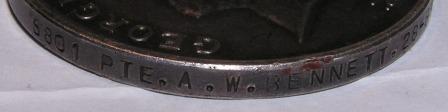
Arthur William Bennett

This search turned in to a pretty tricky one and it was the combined effort of some of my friends that bought it to a successful conclusion.
A couple of weeks ago I received an email from Sandi A who had a British War Medal awarded to 5801 Arthur William Bennett. Sandi's maiden name was Bennett but Arthur was not from her family. From the service record I quickly established that Arthur was allocated to 28th Battalion, AIF, what his parent's names were and that he died of TB in 1918. A Google search bought up a link on the Great War Forum about Arthur which was only a month old. I contacted Charles, who posted the initial enquiry, as I thought it a coincidence that two people were researching the same man at the same time. Charles told me that his interest in Arthur was: 'tracing service personnel who were born (or other wise connected to) Bristol but who had emigrated and enlisted in Dominion forces. Bennett came up as one of these but also as someone who didn't seem to be listed on the CWGC site: a non-commemoration'. How intriguing I thought.
I then sought assistance from my friends Sandra and Drew who provided me with two bits of information which were of great assistance. The first from Sandra was a link to the Wooroloo Cemetery which is near the site of the hospital where Arthur died and the second came from Drew in the form of Arthur's death notice.
It is now that things got confusing. At Woorollo Cemetery there is a memorial to an Arthur William Bonnette, But nothing for a Bennett.
However, Bonnette died on the same date as Bennett, was the same age and from the same battalion. A check of the National Archives gave a nil return for Arthur Bonnette.
The death notice gives Arthur's sister as Mrs Francis and his brother as H.C. Bennett. A search of the electoral roll revealed that Henry Charles Bennett lived at the same address given for Arthur's parents. Mrs Francis proved more difficult to find. On a hunch I searched for a notice of Bonnette and got a hit. An In Memoriam notice for 1928.

This notice gives more clues which led me to believe that Arthur Bennett and Arthur Bonnette were the same person. Additionally, I learnt that his sister was Sarah Lucy Francis. It was back to the electoral rolls and I found Sarah Lucy Francis at the same address as in the service record. The notice also mentions nieces and nephews. I then followed Henry and one of Lucy's children, but they have all died and only in recent years.
My friend Heather (Frev), a very talented researcher, located all the UK census information which confirmed it was one and the same. She also came up with a reasonable explanation as to why the name variation. She thinks that Bonnette is pronounced Bonnay but mispronounced Bonnet. So as to avoid confusion it is possible the name Bennett was used when it suited the family.
Frev also provided me the final clue which broke the case. It was the 1940 death notice for Ellen, Arthur's mother. It mentions a grand daughter, Mrs Phyllis Cherrington and a great grand son. It didn't take long to connect Mrs Cherrington to her son through the electoral rolls and yesterday, 5 minutes after I received the medal in the post I was on the phone to Arthur's great nephew.
Thank you Sandi for sending the medal to me. The returned medal tally is now 1268.


12 April 2013

Find My Past

I have been lucky enough to have had an article published on Find My Past. The story is at this link. The content is similar to the record search tutorial, however, I've added detail on other research resources.
Thanks to Emma of Find My Past for asking me to participate, this is a wonderful opportunity.

06 April 2013

Betty Dow

This search really tested me and it was only in the last hour did it unravel enough for me to connect all the dots.
In January 2012 I received a WWII group of four medals and a plaque awarded to Better Frances Dow. The medals are impressed to B3/227 B. F. Dow. The first thing that threw me was the number which does not appear in the WWII nominal roll. I called on the experts of the British Medals Forum and the answer quickly came back as one attributed to the Red Cross and this was a typical number for a philanthropic organisation. So the first door opened I found out all about Betty. She worked with the Red Cross in Batavia and later in Europe. I've found a photo of Betty which I've attached below.
Using the electoral rolls I followed Betty until 1985 when she died. Betty didn't marry. Her brother Stewart did marry but he had no children. Stewart served during WWII and I now know the wider family have strong military links. Then the trail went cold. Several attempts to revisit the search proved fruitless until tonight when I thought I should go back several generations.
I started with Betty's father, Donald, who was a Presbyterian minister. Donald was appointed as an Army chaplain late in WWI but his service record gives little away that I found useful. I couldn't establish the names of any siblings for Donald so I turned to Betty's mother, Winifred Mona Dow. It took some time to work out her maiden name but once I had it the flood gates opened.
Winifred was the daughter of another Presbyterian minister and was one of seven children. A search using the surname Reid gave me all the names of her sibling which included Stanley Spencer Reid.
Stanley was also a minister but probably more famous for his talents as an VFL footballer. He played for Fitzroy in the first VFL grand final. In 1899 Stanley volunteered to be a chaplain for the Australian contingents who fought in the Boer War. This was unsuccessful so he enlisted as a trooper with the Western Australian Mounted Infantry. While in South Africa Stanley wrote a letter that was critical of a more senior soldier and Stanley was arrested. This was soldier was also connected with the Beaker Morrant scandal. Stanley was detained and returned to Australia. The matter was not pursued and Stanley was commissioned and returned to South Africa. He was in the same unit as his brother Surgeon -Captain Francis Bentley Reid. I take it that Betty Francis and Stewart Stanley were named for these two relatives.
Stanley was wounded on two occasions and subsequently died of his wounds in June 1902. He and  Francis were both mentioned in despatches.
This wikipedia link has the full story about Stanley and several photos of him as well.
Another brother who served was Lieutenant John Cecil Drury Reid who was awarded the Military Cross. John was a member of a Tunnelling Company and died of wounds in June 1917.
Another brother was William Bremner Reid who was also a doctor and it is his daughter, Betty's cousin, who I have found and will return the medals to.
The returned medal tally is now 1267.

Betty in Batavia with the Red Cross


28 March 2013

People's Choice Voting Button

To vote for the Lost Medals Australia blog in the People's Choice Award please click on the button. Once at the Best Blog Competition Page click on Vote Here then scroll down and tick Lost Medals Australia. At the bottom of the page click next until you are at the last page and fill in the details to validate your vote.
Thank you for voting for Lost Medals Australia.
Glyn


27 March 2013

Blog Competition

I have been encouraged to enter the Best Australian Blog Competition. There is a People's Choice Award and voting starts at 1700 on 28 March 2013.
I'll add a link tomorrow for voting and hope that word will be spread amongst my readers.

20 March 2013

Jack Thomson


When medals are awarded they come in two sizes, full size for normal wear and miniature for wearing to a dinner function. It is easy to identify who was awarded the full size medals as there name is on them. Identifying who received a miniature group is close to impossible. It is only when other evidence about the veteran is included do we have a chance. This was the case the miniature medals awarded to Lieutenant Owen Dawes where the medals came with his card and a letter from him. Unfortunately, I have received many other miniature medals that I have no hope of successfully returning.
However, in the same vein as the Dawes return, Bill has a story of his own about miniatures.

With the growing appreciation in families of their parents military service, the miniature medals that were issued to accompany their larger counterpart, once often overlooked, have now come to the fore. This is as families realise that there are two sets of medals in the family not just one and which are just as important.
But researching miniatures or even attempting to carries its own special set of problems, firstly they are not engraved, so that unless you are very lucky and you find documentation that accompanies them, then finding the original recipient or their next of kin, becomes remote. Often they end up in RSL clubs, sometimes on display sometimes not, but essentially unknown, unacknowledged and forgotten. That I find incredibly sad, it is to me, unacceptable.
Our last foray in regard to a set of miniatures, to Lieutenant Owen Dawes took over five years and that was even with a card that had his name printed on it.
However, the situation with the receipt of the medals of VX24886 Jack Thomson, was different. As different as it could be arriving as they did inside an old spectacles case, which in turn had been wrapped in the perennial brown paper parcel. Luckily, what was included in the case was the RSL life Membership Card of the recipient, Jack Thomson. Along with a cryptic note asking for the medals to be returned to Jack’s family.
Well first thought: “Glyn’s record is about to be broken”. Surely the RSL Membership Card would assist? First the club administration - “No, his membership was archived, and never put on computer”
 Then the members - but the simple task of just asking old members of the club “do you remember Jack Thomson?” Usually brought forward the following:
“He was a lovely bloke!”
“Big fella, had a terrible sense of humour”
“Was in a retirement home around here?”
“I think he died some time ago, didn’t he?” a comment often expressed to those quietly sitting around.
But no one actually seemed to remember when or from whence Jack passed away.
The end result being that after several days of going nowhere and with Glyn’s record well and truly preserved, I reverted to what would have been my normal mode of operation, and in retrospect should have been, if I had not opted for what I thought would be an easy option, of taking the RSL Club route.
 So then it was:
Check with War Graves for possible date of death (28 December 2005).
Check Ryerson for Death and Funeral notices.
Success! The Age and the Herald Sun provided 6 between them.
So now to the State Library and its newspaper archives, to look up the newspapers. First to look up the funeral directors and secondly to try and determine the rest of the family and their possible locations.  
It was this after several hours of cross referencing back and forward between old newspaper entries and the BDM’s that finally led me to Jack’s son, Kenneth who now lives in NSW.
Ken was amazed when I rang, He thought Dad’s miniatures were with the other medals which are with his brother in Darwin, whom he planned to ring the moment we hung up.
But first came the inevitable series of questions. Of which the best was “What was my dad’s medals doing in Kilmore? We have no relations there, never have.”
But as is so often the case at the end of a search when I sit down and review the search, the $64 question, and the one that Ken asked, nearly always arises. How did the medal of an ex-serviceman who died in 2005, in Bundoora get to Kilmore from whence they were sent to Jack’s old club in February this year (2013)?
Well I can’t answer that question, and I am not going to try, it may sound as a cop out but after more than a decade of returning medals it is a question, whose path I now studiously avoid.
What is important is that Jack’s medals are going back to his family, and as searches go I do not think I can ask for much more.

The returned medal tally is now 1262.

13 March 2013

Post update - Arthur Barnes

Yesterday's post about Arthur Barnes has been updated with some newspaper articles from Egypt in 1915 and his father's obituary.

12 March 2013

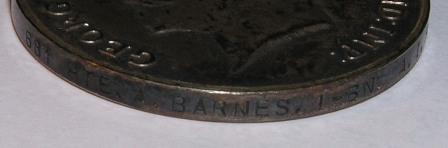
Arthur Barnes

681 Arthur Barnes was an early enlistee for WWI, signing up on 28 August 1914. When he enlisted he was the Town Clerk of Ulmarra in NSW. Being in such a position in the community might suggest that he would be commissioned. However, just like Burnett Gray from the St Kilda council, Arthur chose to enlist. He was one of the original soldiers of 1st Battalion, AIF.
The 1st Battalion, including Arthur, landed at Gallipoli on 25 April 1915. He was declared as missing in action on 29 April 1915 and later confirmed as killed in action on that day. Unfortunately, Arthur was reported as being injured and that he was seen by another soldier in August 1915. This information eventually filtered back to Arthur's family causing considerable confusion. Much of Arthur's service record is taken up with correspondence about Arthur's actual circumstances including letters written by a Member of Parliament. The slowness of communications and the lack of firm information added to the sense of frustration that can be read in Arthur's father's letters to the Army.
The search for a relative of Arthur's was very frustrating but I got there in the end.

Arthur Barnes was the son of Walter and Sarah Jemima Barnes (nee Ware). Walter and Sarah Jemima had three other children but none of them married. Sarah Jemima died in 1893 and Walter Barnes remarried Ellen Townsend who became the step mother to Arthur.
As Arthur's siblings did not marry that line of the Barnes family has died out. So I next started to look at cousins. This led me to Sarah Jemima's brother Uriah Walter Ware. Uriah married Sarah Kate Barr. This was her second marriage, the first to a Mr Moffat who died in a boating accident in the mouth of the Brisbane River. Uriah took Sarah Kate's children as step children.
I did follow another research path through the son of Walter’s second wife Elizabeth Ellen. Ellen’s first husband also drowned, this time in Mackay in 1886. Ellen had one son Samuel Edward Townshend. Samuel trained as a lawyer at Sydney University. Prior to WWI he was the Register at the University of Western Australia. Samuel was commissioned in to the 16thBattalion, AIF on 2 August 1914. Samuel was also killed in action at Gallipoli, this time at Quinn’s Post on 9 May 1915. In one of his letters to the Army about Arthur, Walter mentions Samuel’s death. I learnt a lot of information about the Towshend family from this link and would like to thank Colonel John Townsend and Doctor Richard Townsend for it.
Samuel was the last of that line of the Townshend family and given the step relationships on both sides of this family I believe that the Ware connection is the closest. I have recently been in contact with the step great great grand son of Arthur’s uncle and it is to this family that two of Arthur’s three medals will be returned.

These medals are from the NSW RSL box. The returned medal tally is now 1255.

The following photo is of the 16th Battalion Officer's including Samuel Townshend.
Group portrait of the officers of the 16th Battalion. Identified, left to right, back row: unidentified interpreter; Captain (Capt) Harold Alfred Southern, killed in action on 2 May 1915; Lieutenant (Lt) William Buchanan Kerr, killed in action on 2 May 1915; Capt Leslie Duncan Heming, killed in action on 8 August 1915; Lt John Kingsley Langsford; Lt William Ernest Elston; Lt Harry James Burton, killed in action on 2 May 1915; Lt Edwin Theodore Knight; possibly Lt Gordon Levason Curlewis. Middle row: Lt Alexander Peter Imlay; Lt Robert Balmain Blyth; Capt Eliazar Lazar Margolin; Capt Samuel Edward Townshend, killed in action on 9 May 1915; Lt Ross Harwood; Wilton (no further information); Lt Arthur Edward Carse, died of wounds on 2 May 1915; Habrel (no further information); Lt Ernest Otto Alfred Bruns, killed in action on 2 May 1915; Lt Frank Barnes Gladman; Lt Arthur Henry Torres Mountain, killed in action on 27 April 1915. Front row: Major Francis Bird Carter, killed in action on 27 April 1915; Major Edgar Kendall Baker; Kendrew (no further information); Tilney (no further information); Lieutenant Colonel Harrold Pope; McDonald (no further information); Hon Lt Thomas Gorman (Quartermaster); Major William Owen Mansbridge; Capt James Miller, killed in action on 2 May 1915; Lt Edmund Herman Kretchmar, killed in action on 6 May 1915. Lying in front: Lt Norman Henry Durston, died of wounds on 9 May 1915; Lt Cyril Arthur Geddes, killed in action on 2 May 1915; Lt Kieran Leopold Anderson, killed in action on 2 May 1915.
Photo source:
http://www.awm.gov.au/collection/P05772.003

Update 13 Mar 15
Nick is the relative of Arthur Barnes who I'll be sending the medals to. He has done some searching of his own and come up with two articles about Arthur in Egypt and Arthur's father's obituary.
 Source: http://trove.nla.gov.au/ndp/del/article/61646180
 Source: http://trove.nla.gov.au/ndp/del/article/61646180

 Source: http://nla.gov.au/nla.news-article16613760
At the same time I was looking in to this case, I have been researching an Albert Barnes and I did mix up the names Arthur and Albert but that is fixed now. There are also some formatting issues with the pictures and text I imported which I just can't quite fix.

John Clifford

Over the years we have established several long standing relationships with government or veterans organisations. One which both Bill and I are most proud of is the relationship we have with the RSL at the national and state level. This particular case started with a request from the Victorian RSL state branch. I'll let Bill take up the story of 1385 Trooper John Joseph Clifford, 4th Australian Light Horse.


'John’s British War Medal came to us courtesy of the memorabilia section of the Victorian RSL after it was handed in to them.
John, who served in the 4th Australian Light Horse, was more than qualified for his role; he stated that his employment prior to enlistment was as a jockey. The attached photo, from the AWM, shows the 5ft 7in, 19 year old Trooper Clifford looking every bit the jockey.
Born in Tipperary, Ireland, the search for a next of kin was initially a daunting task. This is despite John, who died in 1925 from injuries and health problems associated with his service, coming from a large family. However, as I worked through the evidence, it became clear that the only practical option was to follow the line from his sister May Margaret Clifford through her marriage to Tom Guthrie. As a result the Victorian Branch of the RSL will soon forward John’s medal to May’s grandson, Michael.'

Bill was very crisp with his research and was able to locate Michael before the RSL could forward the medal to me. That means no picture of the medal but I think the photo of John from the AWM is a fine substitute. 
The returned medal tally is now 1253.
Picture source:
http://www.awm.gov.au/collection/DA11834/

11 March 2013

Web site review - The British Medals Forum


The British Medals Forum has been mentioned many times in posts on this blog and the blog roll contains a link to the site. It is also the site others are most referred to if they are interested in expanding there knowledge, interested in medals awarded to Commonwealth countries or posting requests about stolen medals. Having endorsed the British Medals Forum for many years it is now timely to review the site so that others might consider joining.
The British Medals Forum is commonly referred to as the BMF by members. It is a tightly run forum that is focused on medals, honours and awards that are issued by Commonwealth countries. It is the peak research forum on this subject on the web. 
The BMF uses the phpBB forum package as its operating format. This package is easy to use and navigate around. The BMF use of this format offers the ability to browse by dedicated topic group or pre-selected groupings, for example ‘New Posts’ which is on a 24 hour refresh cycle. The look of the site is utilitarian but this is more to do with the phpBB format than the BMF content. One criticism expressed by members is that the search function often does not deliver expected results. Once again, this can be attributed to the phpBB format and the search operation that is inherent in this package.
It is obvious that the site has a very niche focus on medals. It is a free site which only requires an interested member to sign up to access it. There is no advertising which is a credit to the site operators so there is very little distraction on the site. There is an annual voluntary sponsorship drive which provides the opportunity for members to contribute financially to the running costs of the site and further push away the need for advertising.
The BMF has very clear set of rules which are strictly enforced by the moderators. Topics that stray outside the forum theme are quickly locked and deleted. Topics that have run their course in the discussion about medals are also locked if the conversation strays, however, are left online if the earlier discussions are of benefit to member education. The forum is moderated by a group of very knowledgeable, hand selected enthusiasts. The moderators are spread around the world so that they can bring their intimate knowledge of there own countries medal system to the forum. This also allows for 24 hour moderation and close to instantaneous action if the site is hit by spam or disagreement occurs.
The combination of clear rules and decisive moderation allows the BMF to stay completely focused on its primary objective which is the discussion and knowledge sharing of issues related to Commonwealth medals. This ensures relevance that pertains to the topic. As it is a forum, the different members have different writing skills and provide different levels of contribution. The forum has close to 3000 member, some of whom contributed rarely, if at all, and others who are very active. An average day will see over 250 posts being made.
As the site name suggests this one is based in the UK. This is a minor disadvantage to international users. The ‘New Posts’ refresh time means that international posts often fall outside the reading list for the majority of members when they are most likely to access the forum. To ensure maximum exposure an international member needs to time contributions for shortly after the refresh time. This can be inconvenient and run the risk of gaps in the discussion given time differences. A second minor disadvantage is the name. When referring others to this BMF, the question is often asked why join since it is the British Medal Forum not the Australian Medal Forum. However, once a new member visits they soon see that other Commonwealth countries are well represented and the title is irrelevant. These are two very minor criticisms as it is hard find much at fault with the BMF.
The strength of the BMF is the friendliness of the members and their willingness to share the immeasurable knowledge that they have. New members are made to feel part of the group and questions are answered with speed and politeness. If not, the moderators are quick to act. This adds to the quality of the posts and the research that is shared by members. It must be pointed out that the subject of medals is the start point of many discussions which often lead to previously unknown information about a soldier, his unit, his home town, his family or any number of side topics. As long as there is a link back to the original medal discussion the topics are free ranging.  
The British Medals Forum is a no frills website. However, the quality and depth of the research on the BMF belies this no frills approach. The utilitarian aspect ensures no annoying advertising or spam which adds to the enjoyment of members who are not distracted and can immerse in their hobby.
For anyone with even a passing interest in medals awarded to Commonwealth countries this is a highly recommended website.

07 March 2013

Roy Morgan update

Even though I only posted about Roy Morgan yesterday I thought this was a good enough reason to write an update. This afternoon Roy's family posted the following comment:

Hello Glyn,
I would like to sincerely thank you for you diligent effort in locating my mother to return my dad's stolen medal. Fortunately my nephew had one of dad's medals mounted with a photo of dad soon after his passing now we have all of his medals once more. We as Roy's family are so grateful for their return.

Thank you again Roy's family 


This is fantastic news, Roy's medals will be reunited following this return.

PS can I please ask Roy's daughter to email me at llanwarne80 at hotmail dot com - Thank you.

06 March 2013

Roy Morgan

In recent posts I have spoken about how wonderful it has been to assist the Victorian Police Force on several occasions. This time I have the pleasure of helping out the Western Australian Police Force.
Last week I received an email from Peter W of the Perth Police Station. He had a WWII War Medal and a WWII 60th anniversary commemorative coin  and requested that I have a search for the family.
The medal, awarded to WX41637 Roy Frederick William Morgan, arrived in today's post. This afternoon I had a brief look at Roy's entries in the electoral rolls. This brief look turned in to the whole story unravelling at the rapid rate. I quickly established Roy died in 2002 and that his wife's name was Elsie. A check of the White Pages provided a phone number of a person with the same initials living around the corner from the address listed in the 1980 electoral roll. Always keen to take a punt on leads like this I rang the number and within 5 minutes of deciding to have a brief look at Roy's trail I was speaking to Elsie (sorry Bill).
Elsie tells me that she had been burgled in the past and lost many personal items and money. She wasn't worried about the money but she and her daughters were very upset at the loss of Roy's medals. Now one can be retuned.
The returned medal tally is now 1252.

27 February 2013

Douglas McGuire - a man of many numbers

This search really had me stumped for a while. Firstly, to correctly identify who I was looking for and then to locate the family.
I was contacted last week by Jim T in WA and he provided the naming on a medal as WP37316 D.G. McGuire. This threw me a bit as the service number didn't give me a hit in the WWII nominal roll. I know there are some different letter and number combinations beyond the usual state/militia/2nd AIF/service arrangements but this was really strange.
The only D.G. McGuire who came close to fitting the bill was Douglas George McGuire. The nominal roll entry shows two numbers; 5400 and WX30146. The 5400 number immediately suggested a post WW2 number issued after the Australian Regular Army was formed in September 1947. So I was looking for a soldier who continued to serve but I needed to confirm the link to the name on the medal.
I followed Douglas to his death in 2009 and instantly hit another hurdle. His name was spelt differently - this time MacGuire. So it was back to the start and it was then I confirmed it was the same person. I found records showing that Douglas George MacGuire was born on the same date and in the same location as the Douglas George McGuire on the nominal roll. There must have been a period where Douglas had another number altogether and this is the one on the medal.
Following WWII, Douglas and his wife were posted several times to Ammunition Depots in different states. They spent some time in Albury, NSW and then at Northam in WA. Douglas took discharge in the mid 1960s and they settled in WA. However, not long after this I lost all track of Douglas and his wife, Zelma, until the details I found out about his death. So I turned to his wife.
I found a 1952 death notice for a lady who died in Rockingham, WA which mentioned her grand daughter, Zelma and her fiancée Doug McGuire of Northam. Bingo. Other death notices game me the names of Zelma's siblings. After a couple of false starts I focused on one sister who had an unusual initial-surname combination. After checking the details in the electoral rolls I looked up the name in the White Pages and sure enough there was the same initial-surname combination listed. I took another punt and was soon talking to Zelma's sister.
From her I learned that Zelma and Douglas divorced and she had remarried. The best news was that Zelma is still alive but now goes by the name Thelma. I don't think I would ever have worked that out using the electoral rolls. I've since spoke to Thelma and I'll send her the medal soon, she is then going to pass it to her and Douglas' daughters.
Thanks Jim.
The retuned medal tally is now 1251.

21 February 2013

William Moss

7903 Sapper William Henry Moss was almost 35 years old when he enlisted on 29 June 1917. William was allocated to the Tunnelling Company reinforcements. After training he departed Melbourne late in 1917 and arrived in France on 24 January 1918. His service record suggests that one month later he was in England where he remained until June 1918 and was returned to Australia. The service record gives no indication of the reason for this early return. AIF tunnellers were featured in the film Beneath Hill 60.
William's medal entitlement is the British War Medal and the Victory Medal. He died on 1 May 1935. Thank you to Mrs Marshall who sent me the medal and Anne H who did the research which provided the key that unlocked what I had already put together.
The retuned medal tally is now 1250.


17 February 2013

Service records tutorial post update

Recently, the National Archives of Australia have updated their website. I have now updated my service record search tutorial to reflect this very minor change.

12 February 2013

George Robinson

George Audley Robinson's service record makes interesting reading. He initially enlisted in 4th Bn AIF on 17 August 1914. His service record has a 2nd attestation paper for enlistment in 2nd Bn AIF on 31 August 1915. From the early pages of the record it is clear that George left Australia in October 1914 but was returned to Australia in May 1915 because he had a venereal disease. When he landed back in Australia he deserted before presenting himself to the authorities. It is not until page 22 of the service record that the story becomes clear. The dates of his return and then re-attestation are given and the authority this approved the re-enlistment.
George finally joined his battalion in France in July 1916. He spent some time in hospital over the next couple of years and then in September 1918 he received a gunshot wound which resulted in evacuation to England. George finally retuned to Australia early in 1919.
George's full medal entitlement is the 1914-15 Star, the British War Medal and the Victory Medal. It is the British War Medal that I'll soon be returning to George's grand daughter. The medal is named with George's original regimental number - 227, not his second number - 4570.
I received this medal yesterday afternoon from Roger A who was very keen for it to be returned to the family. Roger is a Canberra local so he dropped it off. A few hours of scratching around led me to Janette (George's grand daughter) who has told me the medals have been missing for many years.
The returned medal tally is now 1249.


09 February 2013

Hubert Wallace

N109749 Hubert Hope Wallace was a member of the militia during WWII rather than the 2nd AIF. I suspect that this was due to Hubert's age. For his serivce he would have been awarded the War Medal and the Australian Service Medal 1939-45. It is the War Medal that I'll soon be returning.
This medal we sent to me by my friend Sandra. Within two minutes of opening the parcel I located Hubert on an Ancestry family tree. 10 minutes later I was in contact with Hubert's grand daughter.
The returned medal tally is now 1248.

30 January 2013

Theodore Keegan

I received the WWII War Medal and Australian Service Medal awarded to QX53670 Theodore Joseph Keegan 1939-45 from Darrel H of the Boulder RSL (WA). This was a little confusing as all the records I could find indicated that Theodore lived in Queensland. I lost track of him in 1963 when he disappeared off the records I could access.
John D who was so successful with the Sergent search also resolved this search and was able to provide me with the name of Theodore's son. I rang Mr Keegan today and confirmed we had the right family and sure enough John's information was spot on. I also learnt that Theodore lived in WA for a period which explains how his medals got there.
The returned medal tally is now 1247.

26 January 2013

Norman Price

The WWI service of 4565 Norman Robert Price seems to be fairly typical based on his service record. He was hospitalised on several occasions, went AWOL on several occasions and spent time in France and England. As per usual the service record doesn't give much indication about where Norman fought but as a member of the 2nd Battalion, AIF, Norman would have been involved in action around Ypers.
What I find interesting from his service record is the correspondence from the mid 1940s where Norman is requestion replacement medals and record of service which were lost. The medal I have is the original Victory Medal that Norman was awarded not a duplicate he would have received much later.
I lost track of Norman around 1946 so I then had to start tracking other family members which included Percy Price who was a POW during WWII. I ran out of leads when the online electoral rolls stop at 1980 so as a last ditch effort I placed a request in the Daily Telegraph In Search column and I have now been contacted by the Price family. Normans Victory Medal will soon me returned to Percy's son.
This medal is from the NSW RSL box and the returned medal tally is now 1245.


25 January 2013

Welcome home certificate

This is another non medal return but an important piece of a families history none the less.
During WWI many communities established patriotic funds so that local soldiers could receive presentation items like fobs and comfort packages with clothing and food items. The practice wasn't as widespread and as well organised during WWII but some communities did make an effort to acknowledge the contirbution for their soldiers.
This certificate was presented to Leonard Keith Fountain by the District of Palmer. I have recently been in touch with a relative of Len and will post her the certificate in the near future.
My friend Sandra came across this and sent it to me along with the dog tags issued to Hugh MacGlashan.

24 January 2013

Another case resolved for the Victoian Police

I was recently contacted by a Detective in Warrnambool, Victoria who had a group of five contemporary Australian medals that were found locally. The Detective wasn't sure if they were the proceeds of a crime or not so he held on to the medals while I looked for the veteran.
This morning I was able to provide the Warrnambool Detectives with the phone number of a young soldier so that his medals can be returned.
The returned medal tally is now 1244.

23 January 2013

Evelyn Spradbery

This is another return that has taken many years of research to bring to a conclusion
I received the Imperial Service Medal awarded to Evelyn Bessie Spradbery in 2006 from Jackie E at Australia Post. A little bit of searching gave us the basics; Evelyn's husband name, the London Gazette entry for the award and her date of death in 1991. It took a little more effort to determine that Evelyn and her husband had a daughter by the name of Gwendoline J Spradbery. That led us down one path of enquiry. After much effort we established that Gwendoline married Brian A Spence. Then the trail went cold.
During my research I even wrote a letter to the local paper and council where Evelyn lived. I did not receive a response from either organisation and I doubt very much that the letter was published. I even went as far as to post a story on this blog in 2011 in the hope that someone might do a search of Evelyn's name and come across my entry.
Several of our researchers have also spent considerable effort looking for Gwendoline, particularly Morris C. All up many hours of research have put together some very thin leads. Last week I decided to revisit this case. I stumbled across an online phone book entry for Gwendoline and Brian living in Kendal, UK. The website didn't provide an address or phone number so I had to think of a different method of attack. I then turned to Brian's name. This led me to come across a 2011 council planning committee document that had recently been posted on line. The council in question was the very one I had written to in 2006.
What this document gave me was the subject of the planning application which in turn led me to other documents that opened up more clues. I learnt that Mrs G Spence was the local coordinator of blue badges for handicapped parking. A letter to the editor of the local paper about this subject gave me the best led yet. Gwendoline goes by the name Gussie. Oh, the paper that Gussie's letter was in was the same one I had also written to in 2006.
Once I had Gussie's name I found another obscure reference to her which included a mobile phone number from 2005. On a hunch I rang that number tonight and within seconds was talking to Gussie. We had a wonderful conversation and I am so pleased that all this effort by countless people has come to such a successful conclusion.
The returned medal tally is now 1239.


.

21 January 2013

Stewart Sergent

This has been one of those searches that has taken several researches many hundred of hours to finally come to a successful conclusion.
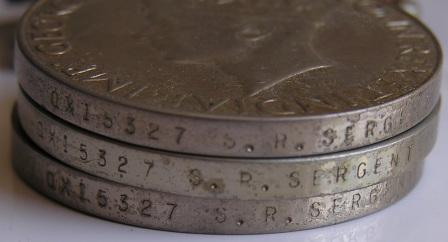
I first received the WWII medals awarded to QX15327 Stewart Raymond Sergent in March 2005. They were sent to me by the Emu Park RSL sub-branch in Queensland. Stewart proved to be very elusive to locate as he had two marriages and children from both of them. His children were all female so we had the added complication of trying to find there married names, if indeed they had married.
After some very detailed research, John D finally managed to crack the code and follow the family path to Stewart's daughter, Dulcie. I am very grateful to John for his persistence with this one. Finally success after almost eight years.
I do have a tinge of disappointment. From September 2006 until July 2008 when I was last posted to Townsville, I worked about 1 km from Dulcie's house.
The returned medal tally is now 1238