27 August 2012

WHEN ANZACS COME MARCHING HOME

This article is the next in my series from guest writers. It is written by Sandra Playle of Vision Research Services and I have kindly been given permission to reproduce it here


WHEN ANZACS COME MARCHING HOME
August 1914 signalled the onset of WW1 with Britain and Germany going to war.  Australia’s Prime Minister, Andrew Fisher pledged the government’s full support for Britain.  This announcement was met with great enthusiasm by Australian’s with many patriotic young men keen to sign up for King and Country.  Others were lured to enlist because they saw it as an opportunity to travel the world.
The First World War, in terms of casualties and deaths, proved to be most costly for Australia and the other countries involved.  When the war began Australia had a population of less than five million yet over 300,000 men enlisted and from those some 60,000 died and approximately 160,000 were gassed, wounded or taken prisoner.  These 160,000 along with the other soldiers that survived the war eventually returned home. (1)
During the ensuing post war years soldiers formed service organizations and governments put projects into place while the communities organised commemorative services, erected memorials, and created honour boards, yet the one thing communities overlooked the most was the soldier himself.  Sadly, many still do.
For many years Australians (in particular, school children) have visited the shores of Gallipoli, the battlefields of France and Belgium as well as the cemeteries where those that died during the battles are buried and commemorated.  They do this to both honour and research our war dead.  However, the soldiers that were fortunate enough to make it back to the shores of Australia pale into insignificance despite the fact that their experiences were much the same.
The soldiers and nurses buried in general cemeteries across Australia appear to have been largely forgotten.  Although some were fortunate enough to be given military funerals, and many have been commemorated with military headstones, there are still too many who have not.  The reasons for the lack of markers are varied, but include the family’s lack of ability to afford the expense.
The most tangible part of WW1 for Australian’s today, would have to be the soldiers of Pheasant Wood that were re-interred at the new WW1 Cemetery at Fromelles in France.  People started to take more notice of the soldiers in their family and this was evident by the many family members who registered with the Australian Army’s Fromelles Project administrators.  The same was also apparent by the number of articles that appeared in the print media and aired on television channels across the country.  More interestingly several schools on the east coast of Australia encouraged their students to research these particular soldiers.  People wanted to know more about these men and families wanted to tell their stories.
COMMUNITY AND EDUCATION
The people and organizations within our communities are integral to preserving history but often they are stymied by lack of funding, volunteers and resources.  It takes some major event before the government’s coffers are opened and sometimes it becomes a ‘feel good’ exercise as opposed to being purposeful in preserving history.
In 2011 the Commission for the Centenary of Anzac released its report.  It is a fascinating document in its scope and content although I am left with questions.
The Commission writes:
“Research by Colmar Bruton identified a common theme that expressed the need for people outside the capital cities to be provided with ways to engage in the centenary to have a local focus for commemorations and to be left with a lasting legacy from the centenary activities.  It was proposed that communities may be engaged in activities centred on refurbishing existing war memorials, honour rolls and avenues of honour.  The Commission agrees that these types of activities would provide opportunities not only for communities to come together to restore and enhance memorials leaving them as a legacy for future generations, but to discover the stories and personal histories that played a part in the development of their communities”.
This is a case of ‘reinventing the wheel’ as such projects happen annually across Australia and are funded by Department of Veteran’s Affairs via the ‘Saluting Their Service’ program.  Whilst the Commission agrees that these projects could be part of the Centenary it does suggest that discovering the stories and personal histories would be worthwhile I was unable to ascertain how they envisaged that this would be done.
Most states in Australia run some sort of educational program outside of the school based curriculum.  However, the most comprehensive outside of the Australian War Memorial that I am aware of exists at the Shrine of Remembrance in Melbourne.  The education officers do an outstanding job of delivering military history to the state of Victoria.  Yet what of the rest of Australia?
Several villages that are near CWGC cemeteries in Belgium and France, run tours for overseas visitors and often include visits to the local museums.  Many schools run an education programmes that study the war and the soldiers buried in their local or nearby CWGC cemeteries.  Furthermore, the school children of those countries, through their various curricula programmes know more about Australian war history and our war dead than we do in Australia, for example, the Harefield Churchyard in Middlesex England where children have been laying wreaths every Anzac Day since the end of the war.  Many schools and historians in Turkey, France and Belgium have portfolios on Australian soldiers buried in cemeteries in the vicinity of their community and I am often amazed at the scope and content of their research.  By the same token, these countries celebrate the various battle anniversaries to the extent that the Last Post is played at Menin Gate every evening to honour the soldiers.  Apart from the Australian War Memorial it is not known where else the Last Post is played every evening in Australia.  It is surprising that the same dedication is not part of the military history psyche in Australia
A number of schools undertook some exciting research into the Fromelles lads, in particular the students from St Mary’s Catholic College in Sydney.  This work is indicative of the potential for the stories of soldiers buried in local cemeteries to be told.  The results of their research can be viewed here:  http://smcchistory.ning.com/ 
In its discussion on student education the Commission says:
“Between 2011 and 2013, the National History Curriculum for Foundation to Year 10 will be introduced by departments of education into classrooms in every Australian state and territory.  The curriculum provides a balanced, rigorous, contextualised approach to Australian, Indigenous and world history, which will enable students to appreciate Australia’s social, economic and political development.  It will help students to learn about Anzac tradition, Anzac Day and other important events and symbols in Australian history”
The Commission goes on to say:
“In regard to the centenary, class – based activities and projects may be introduced into the national curriculum that discuss not only the activities of the First World War, but the role of all conflicts and peacekeeping operations that Australia has been involved in, from the Boer War through to Afghanistan in helping to shape our national identity”.
I have managed to establish what is contained in the Australian History Curriculum concerning the components for Australia’s involvement in war.  In Year 3 students learn about ANZAC Day2, however there is no further detail as to the content in the curriculum.  Then it is not until Year 9 that Australia’s war history appears in the curriculum through studies into WW1:
“World War I (1914-1918)
Students investigate key aspects of World War I and the Australian experience of the war, including the nature and significance of the war in world and Australian history.
·         An overview of the causes of World War One and the reasons why men enlisted to fight in the war.
·         The places where Australians fought and the nature of warfare during World War I, including the Gallipoli campaign
·         The impact of World War I, with a particular emphasis on Australia (such as the use of propaganda to influence the civilian population, the changing role of women, the conscription debate. 
·         The commemoration of World War I, including debates about the nature and significance of the Anzac legend.”
WW2 is introduced to Year 10 students in the following manner:
“World War II (1939-45)
Students investigate wartime experiences through a study of World War II in depth. This includes a study of the causes, events, outcome and broader impact of the conflict as an episode in world history, and the nature of Australia’s involvement.
·         An overview of the causes and course of World War
·         An examination of significant events of World War II, including the Holocaust and use of the atomic
·         The experiences of Australians during World War II (such as Prisoners of War (POWs), the Battle of Britain, Kokoda, the Fall of Singapore)
·         The impact of World War II, with a particular emphasis on the Australian home front, including the changing roles of women and use of wartime government controls (conscription, manpower controls, rationing and censorship)
·         The significance of World War II to Australia’s international relationships in the twentieth century, with particular reference to the United Nations, Britain, the USA and Asia.”

During an email discussion with Paul Kliem, President of the History Teachers Association of Australia, I was able to establish that the content of the curriculum components was left pretty much to the discretion of the teacher thus making the Commission’s ideals for the Centenary celebrations pointless.
Whilst the Commission concedes that the community believes that education is paramount there appears to be a rather large gap between their report and the National History Curriculum content.  Therefore, during such a significant period in Australian history the soldier and his history are passed over once again.
AUSTRALIAN CEMETERIES
The Office of Australian War Graves tend graves of soldiers buried in a general cemetery when they fall into a specific criteria all others are the responsibility of the family.  Very few cemetery authorities tend graves and as family members die or move out of the area the gravesite is rarely visited it falls into disrepair thus obliterating some if not all of the soldier’s history.
Within some State Government legislation there is little protection for cemetery preservation and many cemeteries have been demolished with buildings constructed over the top of the graves at some later stage.  In many cases irreplaceable artworks in the form of headstones have been destroyed along with tomes of historic fact.  Some could consider it to be legalised vandalism and desecration of sacred sites or consecrated ground.  Furthermore, and specifically for Western Australia, the desecration of soldiers graves at Karrakatta Cemetery was described as ‘inevitable’ by the Secretary of the day for the state’s RSL.  In fact, the WA RSL has never publicly taken up the baton to protest about the clearing of soldier’s headstones anywhere in the state nor have they considered introducing a project to record them.  Large sections of Karrakatta Cemetery were completely cleared of headstones without photographs or transcriptions being recorded.  Even as this article is being written, sections of this cemetery are earmarked for clearing.
An example of the types of burial places being obliterated from Western Australia’s military history at Karrakatta Cemetery is that of Corporal Bertie Onions MM and Bar whose headstone was removed during the complete clearing of one of the Roman Catholic sections.  Bertie was born in England, later his family moved to Denmark WA where they took up farming and in October 1916 at the age of 20 he signed up to take part in WW1.  Corporal Onions served with 48th Battalion being wounded twice during fighting in 1918 and his bravery on two occasions saw him awarded the Military Medal and a Bar to that medal.  The citations read:
Military Medal:- "For conspicuous gallantry and devotion to duty during operations 8th/9th August 1918.  During the advance on PROYAT Pte Onion handled his Lewis Gun with great skill and courage in the face of opposition from the enemy.  At one stage, seeing the Company on the right being in trouble by an enemy machine gun, Pte Onion crept out with his Lewis Gun and succeeded in silencing the enemy gun which had already caused several casualties.  When the final objective was reached Pte Onion got his Lewis Gun into position and gave valuable assistance in beating back a party of 20 Germans who were attempting to regain a strong post.  Pte Onion's conduct throughout operations greatly inspired the men around him"
Bar to Military Medal "For conspicuous gallantry and devotion to duty during the advance near LE VERQUIER on the 18th September 1918.  L/Cpl Onion in charge of a Lewis Gun section after the capture of the objective charged a portion of the enemy trench still holding out and preventing our troops on his flank advancing.  Although his No 2 and 3 were shot he worked ahead under heavy machine gun fire, took up a position from where he could enfilade the enemy trench holding up the advance. From here he gave covering fire which greatly assisted the flank troops to advance and finally capture the trench and its garrison who were unable to escape owing to L/Cpl Onion's fire.  His action displayed wonderful dash and initiative which inspired great confidence in the remainder of his section." 
Through a concerted effort within a community coupled with a school education program each and every soldier’s grave, outside of the jurisdiction of the Office of Australian War Graves, could and can be reclaimed, repaired, restored and researched and their story told.  Those well researched and recorded personal histories could be given back to the community via local libraries, local government offices, RSL branches, cemetery authorities and historical societies thus ensuring every soldier in that cemetery has been granted the right to live forever.
CONCLUSION
On ANZAC Day 2012, the talented 117 member Orchestra from Western Australia’s Churchlands Independent State School will play at the opening of the “House of Australians” in Vignacourt in France.  Attending this event will be prominent Australians and Australian Historians.  Perhaps I am cynical but I have yet to see such attention given to an event in Western Australia outside of Anzac Day and Remembrance Day.  Nor have I seen that amount of money dedicated to the memory of soldiers anywhere in Western Australia outside of the state war memorial or the Army Museum.  Perhaps the full potential of the WA Army museum has yet to be discovered.
Paul Kelly of ‘The Australian’ whilst discussing the report of Commission for the Centenary of Anzac in his article “The Next Anzac Century” published 23rd April 2011 wrote; “The report is prudent but disappointing. It reflects an Anzac story that now carries too many expectations and is weighed down trying to satisfy everybody from traditionalists to the peace movement”.  Ironically Kelly missed the way out of those expectations, which is through the stories of the soldiers themselves.  Those individual histories can reshape the story of the ANZACs and breath life into what this generation of men were really like. 
It is those men that came home wounded, scarred, limbless, tortured by nightmares and terrorised by their experiences, it is their stories of what their lives were like and what they achieved post war that need to be told.  These were amazing men who did amazing things.  These are the stories that are beyond Gallipoli, beyond Simpson, beyond Kokoda for every soldier has earned the right to live forever.

Footnotes:
1: A percentage of soldiers did not return to Australia choosing to remain or marry overseas.
2. Days and weeks celebrated or commemorated in Australia (including Australia Day, ANZAC Day, Harmony Week, National Reconciliation Week, NAIDOC week and National Sorry Day) and the importance of symbols and emblems.
REFERENCES


26 August 2012

1914 Star


Following my post about the WWI trio awarded to Douglas Welsh and the 1914 Star in his trio, I have been asked several times about the difference between the 1914 Star and the 1914-15 Star. These links from wiki gives some detail -1914 Star and 1914-15 Star
Even though Australian service men were fighting in German controlled New Guinea in 1914 they did not receive the 1914 Star due to the quailing criteria being for service 'in France and Belgium between 5 Aug and 22 Nov 1914'. These men received the 1914-15 Star. So a 1914 Star is very rear to an AIF soldier as very few qualified for it.
I have also found a very good article on the British Medal Forum written by Geoff Reeves. Geoff has kindly given me permission to reproduce his article.

The following will be a very brief introduction to the 1914 Star. It should cover the basics that the new collector needs to know if they are to collect Great War medals.
General Description:
The 1914 Star (also known as the "Mons" Star after the BEF's fighting retreat to Mons) was authorised in April 1917. Physically it is a 4-pointed Star (though the top point is "hidden" by a crown), approximately 50mm in height and 45mm in width. Additionally there are 2 crossed swords running through the centre of the medal. A scroll appears in the gaps formed by the swords and it reads (from top to bottom) "AUG"; "1914"; "NOV". Finally a wreath runs around the perimeter of the star and at the bottom is George V's cypher. It is not known who designed this medal.
Riband:
The riband is 3 vertical, uniform stripes of Red, White, and Blue - watered (that is, where the colours run into one another slightly).
Clasps:
One clasp was issued for this medal - that for 5 Aug - 22 Nov 1914.
Approximately 387 000 1914 Stars were issued and of these - approximately 145 000 qualified for the clasp. The clasp was authorized in 1919. A rosette was issued for wear on the on the ribbon when medals were not worn. this rosette was to denote the receipt of the clasp to the 1914 Star. Two things about this rosette: 1) it is sometimes seen, in place of the clasp, on the riband of a 1914 Star medal - this is incorrect - it was to denote the clasp when medals were not worn. 2) it is sometimes heard that the rosette was to differentiate the ribbons of the 1914 star and the 1914-15 Star when ribbons only were worn. This is a myth. The ribbons are identical and nothing was done to differentiate them. The rosette on the undress ribbon always denotes receipt of the clasp, not just the 1914 Star.
Qualification: Medal
Qualification for the 1914 Star was for those who served in France or Belgium from 5th August 14 to midnight of 22/23 Nov 14. NB: The Royal Navy did not receive this medal, they received the 1914-15 Star - the exception being those who were at Antwerp prior to 22/23 Nov 14. A list of the units of the RN who qualified can be found below.
Qualification: Clasp
Qualification for the 5 Aug-22 Nov clasp was for all those who were under fire between those dates. "Under Fire", as I understand it, meant those serving within range of the German mobile artillery (in other words - within a couple of miles of the front lines).
Naming:
All 1914 Stars are impressed in block capitals - in 3 lines - with the recipients Number, Rank and Name, and unit (with line infantry the battalion number is often included - something not seen on later medals).
This, as I stated in the opening lines, is a very basic piece on the 1914 Star and its characteristics. There are exceptions, nuances, and variations associated with this medals - as there are with all medals - but the scope of this article is only to familiarize the beginner with what he or she needs to know.
The research potential for the 1914 Star is, like all other Great War medals, fairly good. MIC's (Medal Index Cards) are available online from the National Archives website and can be downloaded in .pdf format for £3.50. A visit to the NA, at Kew in Surrey, may yield more information in the form of the soldier's service record. If you cannot make it yourself there are researchers who can be hired to do this.
Two caveats here: you might be disappointed to find that the soldier's record did not survive - as a portion of the Army's service files were destroyed during the London Blitz. I believe, however, that the RN and RAF files survived unscathed. Nevertheless it is always worth looking.
The second caveat is to choose your researcher carefully - shop around, as you would when looking for any professional service - some are better than others, and there's no point in paying someone £20.00 of your hard-earned money to tell you that no record was found, when one does indeed exist (and I'm speaking from personal experience here). So, ask several different people whom they would use and then contact the researcher and ask them about their rates and exactly what services they provide. Do they do the research themselves or do they have research assistants (who may or may not be as qualified) do the actual legwork? What papers, if extant, will they be searching for? (I've heard of some people paying good money to just get the MIC and an extract from the regimental history - something you don't need a researcher for!) What fees will they charge: are the fees the same whether the researcher is successful or not? Anyway, you get the idea.
Other sources of research are the relevant war diaries (a record of the battalion's day-to-day activities that will often list officers - it is rare, however, to see an other-rank listed by name), the Regimental Histories (once again, usually only officers get mentioned by name, but many have casualty lists and gallantry rolls for all ranks), Regimental museums (some are more helpful than others but it never hurts to inquire), Regimental Journals (often can be found in used-book stores - I've found many to my regiment of interest at these sorts of places), various military history or regimental websites, and of course, fora like these (especially this one!)


These photos show an example of both medals:


24 August 2012

Welcome home badge

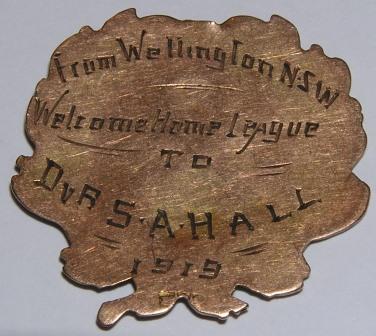
The final item that came to me recently from the NSW RSL was a welcome home badge presented to 2185 Driver Stewart (Jack) Arlington Hall. These badges were very common after WWI and the patriotic groups of towns and communities presented them to locals who enlisted. This particular badge was presented by the town of Wellington in NSW.
The search for Jack's family stalled a bit until I located his death notice and found the names of his daughter, her husband and their sons. What this notice didn't give me was Jack's daughter's married name. Luckily, her first name is an unusual spelling and by process of elimination I narrowed down the candidates to one likely family. By combining this surname and the name of Jack's grandson, which I had got from the death notice, I found a person of this name on the internet. I took a punt this morning and sure enough I had the right family.
Jack's grandson tells me he has Jack's medals so this will add to the family collection.


It looks as though a ring at the top of the badge has broken off as well as one of the stems at the bottom left. The badge is about the size of a 10c piece.

Masonic Medals

I've almost completed the research on all the items I received from the NSW RSL on 20 August 2012.
The three Masonic medals in the package date from the 1950s and were engraved with the names D.S.L Keay and A.R. Keay. Ancestry provided the full names as David Smith Laing and Allan Richmond, both living in New Zealand. From the Auckland War Memorial Museum website I found these details about David.
Having David's full name led me to another website belonging to Mr Nigel Keay. Nigel is a composer and violinist who lives and works in France. A link on Nigel's web site has a wonderful collection of WWI photos of David and of some of the sights he saw in Egypt. This link is to David's obituary.
Nigel is the grand son and son of David and Allan. His brother lives in Sydney so I'll return the medals to him.
All that remains from the items I received from the NSW RSL is a WWI badge and I hope to finalise that case today.
The returned medal tally is now 1181.


23 August 2012

N.T. Aisbett - WWII War Medal

In the previous post I mentioned that I had recently received several items from the NSW RSL. One of these was a WWII War Medal. This particular medal was awarded to NX174153 Noel Travers Aisbett. I found Mr Aisbett easily enough in the NSW electoral rolls and noticed that he was at the same address for many years. Following a hunch I looked up Mr Aisbett in the White Pages and sure enough there he was still at the same address.
This morning I had a lovely chat with Noel. He tells me that he lost his medal about a year ago when is fell out of a bag. This bag also contained his other four WWII medals. So not only is this medal going to be returned to the vetern it will be reunited with the rest of his medal group.
The returned medal tally is now 1178.

21 August 2012

Australian Service Medal and Australian Defence Medal

Sometimes I wish all the searches we do where as easy as this one.
Yesterday, I received a package from the NSW RSL. The package contained two contemporary Australian medals, a WWII War Medal, a WWI badge and a collection of Masonic medals.
The contemporary medals are the Australian Service Medal and the Australian Defence Medal. From the number I suspected that the recipient was in the RAN. A quick check of the Defence phone directory today gave me a possible candidate so I fired of an email. As it happens the CO of the ship this chap is posted to is a good friend of mine so I made a quick call and confirmed I had the right person.
I now know that the medals were stolen recently but will soon be back with the owner.
I have the phone number of the WWII veteran and the grand son of the WWI veteran whose medal and badge were in the package. I'm just waiting for them to return home so I can give them each a call.
The returned medal tally is now 1177.


16 August 2012

Francis Perret - Merchant Navy

I have about five medals awarded to Merchant Navy men which are proving difficult to research. There are some Merchant Navy details on the WWII nominal roll but this is a bit hit and miss. So researching medals awarded to men who served in the Merchant Navy is not the easiest.
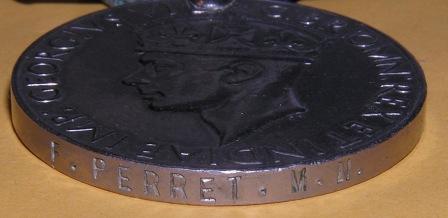
I recently received a War Medal awarded to F Perret from Andrew G a fellow Army officer who I've know for many years. Even with such an unusual surname Perret proved hard to pin down. The only reference to him in the National Archives was an application for war medals made in 1947. Although the initial was the same the application didn't provide the complete name. Digging in to Ancestry proved to pull all the threads together and I've recently been in contact with Perret's family.
I now know that his name was Francis and he worked as a cook on merchant vessels prior to the war. He continued to serve in the same capacity during WWII which earned him this medal.
The returned medal tally is now 1175.


This example show that RAN naming is more pronounced that medals awarded to the Army.

07 August 2012

Prison Governor Lewis Ball

This post is a continuation of including guest writers on my blog who have produced interesting articles relating to Commonwealth medals.
This article originally appeared on the British Medals Forum and is a fascinating piece of research. For anyone who watched British WWII movies the name Lord Haw Haw will be familiar. This story is about the career of Lewis Ball who was the Prison Governor who presided over the hanging of William Joyce who was Lord Haw Haw. I am very grateful to Lloyd of the BMF for giving me permission to reproduce this article. Lloyd has been mentioned on this blog before when he assisted Bill and me locate the family of  Lieutenant Commander George Raymond Grandage.
For anyone with an interest in medals I highly recommend becoming a member of the British Medals Forum.
 
Prison Governor Lewis Ball


Lewis Ball was Governor of His Majesty’s Prison Pentonville when the spies Waldeburg, Meier and Kieboom were hanged in 1940, and Governor of HM Prison Wandsworth when the traitors Jon Amery and William Joyce were hanged in 1945 and 1946. Ball’s active service in two wars from 1916 to 1919 was really an interruption in a forty-year career with the Prison Service, most of which was spent as Governor of various prisons including, in addition to Pentonville and Wandsworth, those at Usk, Preston, Liverpool, Birmingham, Manchester (Strangeways) and Wormwood Scrubs. The Germans and the tribesmen on the North-West Frontier of India would probably have been no match for the hard men that Ball had to deal with in the UK throughout his working life.

Lewis Cecil Ball was born on 21 July 1887 at Luton, Bedfordshire, at that time a rural area outside London. His father George was an advertising inspector. By the time of the 1891 census (and in 1901), the Ball family were living in Tonbridge, Kent. Lewis Ball was educated at Sir Andrew Judd’s Free School in Tonbridge (now Tonbridge School), and according to his army papers, Lewis Ball was also educated at King’s College, on The Strand, London.

On 27 October 1903, when he was aged just 16, Ball was registered as a Temporary Boy Clerk in the Civil Service (London Gazette 30 October 1903). On 15 November 1907, by which time he was 20, Ball joined the Prison Service with his appointment as a Second Class Clerk in a Prison (London Gazette 3 December 1907). With a break for war service, he would be a member of the Prison Service for the next forty five years.

Lewis Ball’s first prison was HMP Knutsford, in Cheshire, where he served from February 1908 to March 1912 (with a four-month stint in 1910, possibly for training, in the Home Office). From March 1912, still as a Second Class Clerk, Lewis Ball was posted to HMP Liverpool (also known as Walton Gaol), a larger and tougher establishment than Knutsford.

After the outbreak of war in 1914, severe pressure was put on prison staff by enlistments into the armed forces. Lewis Ball, aged 27, did not immediately enlist. In the last quarter of 1914 he married Florence Steel in Tonbridge, and moved her back to Liverpool. In December 1915 Lewis Ball presented himself to the army, and was attested and examined. He then went back to Liverpool Prison to await his call up.

Ball was mobilized on 24 March 1916 and was appointed into the ranks as a Gunner in the Royal Garrison Artillery. He served in the UK to 25 October 1916, when he was sent to the Western Front for his first war.

Arriving in France on 26 October 1916, Gunner Ball was posted to 13th Siege Battery RGA. The battery’s services during the time that Gunner Ball served at the front have not been researched, however it is certain that he would have seen considerable action, and also endured the conditions of the miserable winter of 1916/17.

Although he remained a Gunner, Lewis Ball must have exhibited some leadership qualities because in April 1917 he applied for a commission in the RGA. In July, as the majority of the batteries on the Western Front were concentrating for the terrible Battle of Ypres, Gunner Ball was ordered back to the UK to attend an Officer Cadet Unit.

After eight and a half months’ active service, Lewis Ball was back in the UK by 13 July 1917. After a spot of leave in Tonbridge and possibly a spell in hospital (parts of his service papers are illegible), Ball joined an Officer Cadet Unit at Fort Brockhurst, Gosport, on 24 October 1917.

Lewis Cecil Ball was commissioned as a Second Lieutenant in the Royal Garrison Artillery on 1 April 1918. Although the German offensive was raging on the Western Front, from his papers it appears that Ball never returned to the Great War – even though his British War Medal and Victory Medal are named to him as an officer. Instead, after a further three months in the UK, Second Lieutenant Ball was posted to India – and indirectly, to his second war.

Ball embarked at Southampton on 4 July 1918, and disembarked at Bombay on 13 August 1918. By 18 December 1918, Second Lieutenant Ball was with 1 Mountain Artillery Brigade – armed with small mountain guns rather than the siege guns he was used to – at Peshawar, then on the north-west frontier of India. He was posted to 6 British Mountain Battery, and was with the battery when the Third Afghan War formally erupted on 6 May 1919.

One of the precursors to the Third Afghan War was the Amritsar massacre in May 1919 – an event that was to have minor repercussions for Lewis Ball more than twenty years later. While 6 British Mountain Battery took part in the campaign in 1919, it does not appear to have been heavily engaged and owing to the number of batteries on lines of communication and guard duties the activities of the battery are not clear from available records. The campaign was certainly difficult for all participants, with the majority of casualties being caused by the climate and poor sanitary conditions.

Second Lieutenant Ball was absent from his unit for one week during the campaign – the reason cannot be deciphered from his service record. He was certainly present with the battery in the field on 24 June 1919, but shortly after received demobilization orders and made the long journey from the north-west frontier to Bombay, where he embarked for the UK on 20 July 1919.

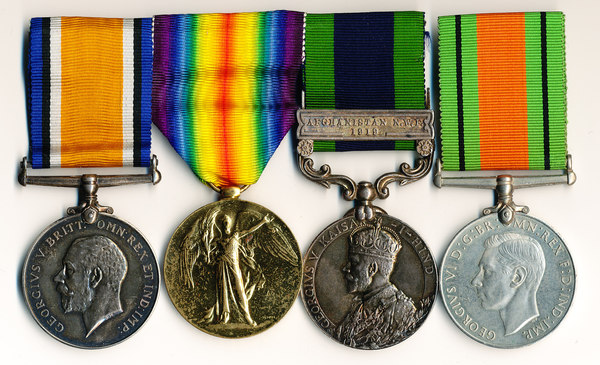
Lewis Ball was disembodied on 27 September 1919 and transferred to the Reserve. His date of promotion to Lieutenant was dated, strangely, 1 October 1919. For his three years of service, Ball received the British War Medal, the Victory Medal and the India General Service Medal 1908 with the clasp ‘Afghanistan NWF 1919’. The ribbons would be worn frequently.

Unlike a lot of men returning after several years away, Lieutenant Lewis Ball had a job waiting for him, in the Prison Service. He was now aged 32, and in addition to his pre-war service as a clerk in two prisons, had broadened his experience of life and men – and discipline - with active service in two wars. With effect from 1 January 1920, Lewis Ball was appointed a Governor, Class 5 – the lowest of the five ranks of prison governors – of HM Prison Usk, in Monmouthshire.

As the senior officer, prison governors were responsible for all aspects of prison life, particularly security and the maintenance of prison discipline, and supervision of the prison officers. A daily inspection of the prison appears to have been a major part of the governors’ routine. They could reward or punish prisoners, were responsible for ensuring that prisoners’ mail was read and, because of their statutory responsibilities, any overnight absence from the prison had to be approved by the Prison Commissioners in London. The governors were almost as institutionalised as the prisoners themselves. One of the mandatory duties of prison governors was to attend executions – hangings – and Lewis Ball witnessed many of these in his long career.

At the time Lewis Ball was appointed a prison governor, the Prison Service of England and Wales was going through one of its regular reviews. English Prisons Today – Being the Report of the Prison System Enquiry Committee, published in 1922, probably gives as good a snapshot as can be obtained on the system in which Lewis Ball became a very senior officer. The Enquiry Committee was very critical of Prison Governors, particularly the process for their selection and the “almost exclusively disciplinarian attitude” of the Governors themselves.

The Committee apparently endorsed the view of a chaplain that men promoted from within the Prison Service to be governors were ‘toadies to those above them and bullies to those below’. The Committee concluded: ‘Generally, we should say that governors are men of limited knowledge, disciplinarians, lacking in imagination, sceptical about new proposals, but conscientious and just.’ It is impossible to know where Lewis Ball fitted into all this, although in a footnote to the report the Committee noted:

Recently a number of civil service clerks connected with the prison system have been made governors. This has aroused considerable criticism among prison officers, who complain that they have no knowledge of discipline duties. This clearly was a reference to men such as Ball.

Promoted Governor Class 4 in April 1921, Ball remained at Usk until April 1922, when the prison was closed. It was at Usk that Ball oversaw his first hanging – William Sullivan was a 41 year old convicted murderer that went to the scaffold on 23 March 1922. Sullivan was the first of more than thirty murderers, spies and traitors that Lewis Ball was to see die at the end of a rope, at Liverpool, Birmingham, Strangeways, Pentonville and Wandsworth.

From Usk, Lewis Ball was transferred back to his old prison, Liverpool. He had left in 1916 to go to war as a Gunner; six years later he was back as the Guv. Promoted Governor Class 3 in May 1925, Ball was transferred to Preston. Another promotion, to Governor Class 2 in December 1929, and after another four years, in May 1931 Ball was sent to Birmingham.

On 21 March 1935, aged 47, Lewis Ball was promoted to Governor Class 1, the most senior governor rank in the prison service. With the promotion came another transfer, to Strangeways Prison, Manchester. While at Strangeways, Ball oversaw the hanging of one of the most sensational murderers of his day, Dr Buck Ruxton, who had killed, mutilated and dismembered his wife and her maid. Many members of the public were convinced of Ruxton’s innocence, and a petition urging clemency was signed by more than 10,000 people. Lewis Ball saw Buck Ruxton executed on 12 May 1936.

The outbreak of the Second World War brought significant challenges to the Prison Service. For the first time, prisons came under air attack, and there were significant staff shortages and other pressures. Strangeways was in an area assessed as likely to come under air attack, and many of the prisoners with short sentences remaining were released.

The most dangerous place for the Prison Service was London – and this is where Lewis Ball was to serve from March 1940 to the end of the war, in Pentonville, Wormwood Scrubs and finally Wandsworth. Ball was made Governor of Pentonville in March 1940, serving there only until 1942 when the prisoners were moved out and most of the buildings handed over to the army ‘for the duration’.

While at Pentonville, Ball was present at the execution of Udham Singh. Singh, an Indian independence activist and revolutionary was hanged on 31 July 1940 for the assassination of Sir Michael O’Dwyer, GCIE, KCSI, former Governor of the Punjab. It is not known if Ball wore the ribbon of the India General Service Medal when he attended Udham Singh’s execution. If so, Singh should have recognised it as he was a recipient of the medal himself. Singh is still regarded as a patriot and hero in India; his body was eventually exhumed from Pentonville and repatriated to India in 1974.

Carl Meier, Jose Waldeburg and Charles van der Kieboom, also hung at Pentonville under Lewis Ball’s eyes, were three of sixteen men executed in the UK for spying in the Second World War. Waldeburg was German while Meier and van der Kieboom were Dutchmen, all of whom had landed on the South Coast and were caught almost immediately in possession of a short wave radio transmitter and a quantity of pound notes. They were tried under the Treachery Act 1940, and convicted in November 1940. Waldeburg and Meier were hanged by the famous hangman Thomas Pierrepoint (who would have been well-known to Ball) on 10 December 1940. Kieboom went to the gallows a week later.

When Pentonville was put into mothballs, Lewis Ball was transferred to another famous institution, HM Prison Wormwood Scrubs. He served as Governor at the Scrubs for three years, from January 1942 to January 1945, when he went to his last prison – Wandsworth.

Lewis Ball was Governor at Wandsworth from 1 February 1945 until 1947. Wandsworth had been bombed repeatedly and in March 1945, not long after Ball took over, the prison was hit in the penultimate V2 rocket attack on London. The V2 crashed and exploded near the deputy governor’s house.

The years 1945 to 1947 saw no fewer than 15 hangings at Wandsworth, which Ball as Governor was obliged to attend. The murderers included Robert Blaine, executed in December 1945 for the murder of Captain John Ritchie of the Canadian Army, and the Polish black marketeers Marion Grondkowski and Henryk Malinowski, executed on the same day in April 1946 for the shooting of ‘Russian Robert’ Martirosoff.

Two men were also hung for treason at Wandsworth under the watchful eye of Lewis Ball. They were tried and convicted under the Treason Act of 1351. John Amery, the son of a cabinet minister, had made broadcasts from Germany and had exhorted Allied prisoners to fight for the Germans on the Russian front. Famously, his trial lasted just eight minutes and he was hung on 19 December 1945 after a stay of several weeks at Wandsworth.

William Joyce, nicknamed ‘Lord Haw Haw’ because of his accent and trademark ‘Gairmany calling’ at the start of his radio propaganda broadcasts, was perhaps the most famous British traitor of the war – despite being a US citizen. Joyce was extremely complimentary of the care and attention given to him by the Prison Service over his last months, and was transferred to Wandsworth not long before his execution. He was hanged by Albert Pierrepoint at 9.00 am on Thursday, 3 January 1946.

After being a prison governor from 1920, in 1947, aged 60, Lewis Ball was promoted to Assistant Director in the Prison Service, at Horseferry Road, London. He was one of four assistant directors, serving under six directors, the whole under the Chairman of the Prison Commission. It must have been quite a change for Ball, although the salary – about £1300 – was very generous.

Lewis Ball worked as an assistant director until his retirement in 1950. As a member of the Prison Service during the Second World War, Lewis Ball was eventually awarded the Defence Medal. It was a small enough reward, as Ball received no Jubilee or Coronation medals, nor any other honours, for his many years of service.

Although a considerable amount of information has been unearthed on Lewis Ball’s official duties as a senior prison official, no information has been found on his character or personality. Most prison governors were hard and even harsh men, and tough disciplinarians. With his very long service in some of the hardest prisons in England, Lewis Ball may have been a hard man. Or, coming as he did from the clerical staff, he may have been reform minded, within the parameters of the day. Regardless, he must have had a strong sense of duty and been a strong leader.

It is not known yet whether Lewis and Florence Ball had children, or whether Florence survived her husband. Lewis Cecil Ball appears to have remained in London after his retirement; his death was registered in Croydon in the third quarter of 1966, when he was aged 79.

Horace Soppa - Australian Service Medal 1939-45

Horace Leslie Soppa initially served in the militia as Q66183 in the 1st Labour Company. He later transferred to the 2nd AIF as QX21025 and served in the 2/26th Battalion. As his number indicates, Horace was from Queensland and the electoral rolls show that he remained in Queensland after the war.
Unfortunately, the medal disc has come away from the suspender and where the rest of his group is remains a mystery.
Horace's medal will be returned to his family who are still in Queensland and thank you to Shirley F of Mt Magnet who sent the medal to me in the first place.
The returned medal tally is now 1174.

30 July 2012

Benedict John McNamara

Medals come to us is all sorts of condition. Some arrive as if they had only recently been issued even thought they are close to 100 years old while others have well and truly seen better days.
The Australian Service Medal 1939-45 awarded to NX113858 Benedict John McNamara most definitely falls in to the second category. As the photos show the pin for attaching the ribbon is missing, the edge is damaged and the metal is discoloured. However, the naming is still quite visible.
This medal will be sent to Ben's nephew and thank you to Grant B who forwarded the medal to me.
The returned medal tally is now 1174.


13 July 2012

Frank Boyd - update

In May I posted the story of the WWII medals awarded to Frank Boyd. We did this research on behalf of the Gaythorne RSL in Queensland. This is the local news paper article about the return.

12 July 2012

Colour Patches

Along with the many questions I receive about medals award to Australians I also get some enquiries about military history in general. In recent times I've received a number of questions about the colour patches that have been worn, and continue to be, by Australian soldiers. In cases like this I refer them to the web site of my friend Phil: colourpatch.com.au
As a result of this increased interest in colour patches, Phil has kindly given me permission to republish his web page which gives the history of colour patches.

The Australian Army wore colour patches from 1915 to 1950, as a means of distinguishing units. In July, 1987 it was decided to permit the wearing of colour patches again, on the puggaree of the hat khaki fur felt; the decision was influenced primarily by the need to foster the Army's heritage.
Two series of Unit Colour Patches (UCP) are approved for the Australian Army:
a. Series I are the patches of units of the 1st AIF and the whole Army from 1921 to 1949.
These are worn by units which have established their lineage and similarity of role to those earlier units. A small number of these patches have been used as a base for Series II patches for organisational reasons, others as a basis of completing pattern gaps to provide continuing heritage; these patches are referred to as Series I (Extended).
b. Series II, introduced in 1995, is based largely on the colour combinations of Series I which indicated headquarters, corps and some functions. These are arranged as square base patches identifying Headquarters Australian Defence Force (Air Commander), Army Headquarters and the functional command headquarters. Smaller overlayed shapes in various colours identify uniquely non-corps units under command of those headquarters, and corps units respectively. These patches are worn by units which have not established lineage and similarity of role for a Series I patch.
Entitlement to the wearing of a Series I colour patch is subject to substantial evidence being produced as to clear and direct lineage from a World War l or World War 2 headquarters, unit or independent sub-unit which had an approved colour patch, and a role similar to the present day unit. Granting of the entitlement must be shown to be a factor in significantly enhancing unit esprit-de-corps and morale.
As of May 2012, 97 Series I colour patches have been approved for wear.
The uniquely Australian system of colour patches may have been inspired through the South African War 1899-1902 by some British Army units wearing small cloth patches in colours or tartans appropriate to their regiment on the puggarees of their pith helmets. The Australian system however, was an extension of the system of small flags nine inches square allowed by Headquarters 1st Australian Division in 1914 to mark headquarters and unit lines; AIF Order No. 10 issued in Melbourne on 5 September 1914 provided for these flags in colours, which, with several minor changes, were the basis of the 1st Division's colour patches. Divisional Order No. 61 issued at Mena, Egypt on 6 March 1915 indicated:
'Badges 562. In order the better to distinguish the several units of the Division, coloured patches of cloth 1 1/4 inches wide by 2 3/4 inches long will be worn on the sleeve one inch below the shoulder seam. Except in cases of Headquarters of Brigades and the Divisional Artillery, the Engineers and Army Medical Corps, badges will consist of two colours, the lower indicating the formation, the upper the unit etc. Light Horse (4th Light Horse) and Artillery badges will be divided diagonally, the others horizontally.'
(A table giving the layout in detail followed)
Later in 1915, 1st Division Standing Orders paragraph 35(ii) re-promulgated colour patch detail amending the artillery identification to one colour patch only for all divisional artillery, of crimson over royal blue in a diagonal setting, and replacing the yellow as the colour of the second battalion in each brigade with purple. The Headquarters 1st Brigade colour patch was a green horizontal rectangle, and its battalions (1, 2, 3 and 4) black, purple, brown and white over green divided horizontally. The same system applied to the 2nd Brigade, whose brigade colour was red, with battalions numbered 5 to 8, and to the 3rd Brigade whose brigade colour was light blue, with battalions numbered 9 to 12. Divisional engineers and the signals company wore a purple colour patch, the divisional 'train' (Army Service Corps) dark blue over white and medical corps chocolate. Later divisional unit colour patches were the pioneer battalion wearing a white patch with a purple centre, machine gun companies (later battalions) wearing a black patch with a yellow centre, ordnance dark blue with a red centre, pay corps blue with a gold centre and veterinary maroon. The divisional headquarters patch was black with a white centre. Machine gun units also wore 'crossed guns' in yellow cloth directly below their colour patch, and trench mortar batteries a grenade in blue worsted embroidery directly below the divisional artillery patch if medium mortars, below the brigade headquarters patch if light mortars.
The 4th Brigade, raised separately and never part of the 1st Division, gained approval from Headquarters Australian and New Zealand Division in March 1915 to wear colour patches on the left side of the helmet puggaree, or cap or hat band, the patch measuring l 1/2 inches by 2 1/2 inches, as a horizontal rectangle. The Brigade colour was dark blue and the upper/battalion colours as for the 1st Division; because however, the black and purple of 13 and 14 Battalions over the Brigade dark blue base caused confusion with the Brigade Headquarters' patch, the upper colours for these battalions were changed to light blue and yellow respectively. The Brigade later conformed to the 1st Division method of wearing the patches at the head of the sleeves of jackets.
As other divisions of the 1st AIF were formed, they were allocated distinctive divisional shapes -diamond for the 2nd, horizontal oval (sometimes described as ellipse) for the 3rd, circle for the 4th and vertical rectangle for the 5th. The 6th Division, partly formed in England in 1917 to provide reinforcements for the other divisions, but later disbanded before it saw action, was to have worn a vertical oval patch. The 4th Brigade retained its original rectangle patches although allotted to the 4th Division; other anomalies were the 12th Brigade of the 4th Division, which had a dark blue brigade colour with consequent adjustments to the colours of its first and second battalions (45 and 46), and the 8th Brigade allotted to the 5th Division which had yellow as the brigade colour.
The light horse brigades followed the horizontal rectangle shape, with the exception of the Headquarters (only) of the 4th Light Horse Brigade and the whole of the 5th Light Horse Brigade, which used a triangle shape. All colours being separated diagonally, brigade headquarters and brigade/lower colours were, for 1st, 2nd, 3rd and 4th Brigades respectively white, red, yellow and dark blue. 5th Brigade also used red, but in the triangle patch. The upper/unit colours in each brigade were, for the regiments in seniority, light blue, green and black, and for the brigade machine gun squadrons, field ambulances and veterinary sections, respectively purple, chocolate and maroon.
Nearly 300 colour patches were authorised during World War 1, some initially by divisional orders, the majority later by AIF Orders; included were a number of colour patches later amended or cancelled.
In 1921, Military Order 206/21 indicated as follows:
(1) The new organisation (CMF) being based on the AIF, authority has been granted to Citizen Forces to wear Regimental Colour Patches on the jacket, similar to those worn by units of corresponding designation of the AIF
(2) The above privilege has been accorded to the Citizen Forces, but ex-members of the AIF serving in Citizen Forces will wear in addition the colour badge (sic) (in miniature) of the unit with which they last served in the AIF. (... to be worn 1/2 inch above the Citizen Force colour patch)
Standing Orders for Clothing 1922, including a colour plate, formally authorised 'Distinguishing Colour Patches'. Later authorities were Standing Orders for Clothing 1925, Standing Orders for Dress 1931, and finally Standing Orders for Dress 1935 with later amendments. Some 180 colour patches, primarily those of the AIF, were depicted in the colour plate issued with the 1935 Orders; included however were nine Permanent Troops, two Fortress Troops and eleven non-divisional unit colour patches, apart from the two cavalry and five infantry divisions.
On the outbreak of World War 2 and the raising of a 2nd AIF, it appears that 2nd AIF units may have initially adopted the colour patches of their identically numbered or designated 1st AIF forbears, in the absence of any formal instructions. However, probably in April or May 1940 and partly due to the number of battalions in brigades being reduced from four to three, an instruction was issued allocating grey background colour patches to 2nd AIF units and giving infantry battalions colour patches by shapes and upper and lower colours indicating the divisional, brigade and battalion seniority of their 2nd AIF grouping. This resulted in a significant number of battalions wearing colour patches unrelated to those of their 1st AIF forbears. For example, the 2/14th Battalion, at that time being the senior battalion of the 'third' brigade of the 'second' division of the 2nd AIF (the 7th Division), was allotted a diamond-shaped black over light blue patch on the grey background; the black over light blue diamond was the colour patch of 25 Battalion 1st AIF, while 14 Battalion 1st AIF wore a yellow over dark blue horizontal rectangle. There is considerable evidence of this instruction's impact in unit war diaries and official histories, however, no copy of the authority, believed to be an Army Headquarters (AHQ) Director of Ordnance Services instruction with colour plates, has yet been located in searches of Australian War Memorial and Australian Archives holdings of AHQ files of April-May 1940.
As a result of representations to members of Parliament by 1st AIF associations and the RSL, this anomaly was corrected in October-November 1940 by the issue of another instruction, probably again by AHQ Director of Ordnance Services. The colour plates assumed to have been issued with the instruction would have depicted divisional-shaped grey background patches (6th horizontal rectangle, 7th diamond, 8th horizontal oval and 9th circle), with battalion colour patches conforming with those of the 1st AIF forbear superimposed. These battalion patches were half-size where the divisional and battalion patch shapes were different, and in full size yet showing a 1/4 inch grey background where the shapes were similar. Due to a significant variety of different shaped patches resulting from regroupings, the 9th Australian division in 1943 was given authority (General Routine Order (GRO) 225/43) to wear the distinctive ‘T' patches which in effect also commemorated the major part played by the division in the Siege of Tobruk. These colour patches were illustrated, with two minor errors (2/28 and 2/48 Battalions), in Appendix 4 to 'To Benghazi' by Gavin Long (Australia in the War of 1939-45 Series 1 (Army) Volume 1).
By the end of 1944, close to 600 colour patches had been introduced during World War 2, not including changes in colour patch by the addition of the 2nd AIF grey background by militia units transferring to the 2nd AIF. Because of complexities that had arisen, the C in C AMF directed eventual adoption, except for headquarters, artillery 'branches', armoured, cavalry and infantry units, of colour patches of elongated horizontal rectangle shape, to indicate only the corps or 'service' of the wearer. These were promulgated in 1945, but it appears that many units had not adopted them by the time the war had ended. A small number of colour patches were approved for the Occupation Force for Japan in 1945 and 1946.
Authorities for colour patches in World War 2 included, to a limited degree Standing Orders for Dress 1935 as amended, AHQ instructions issued principally by the Director of Ordnance Services, and AIF (Middle East) GEO until 1942. In that year GRO issued by AHQ were introduced as authorities and until 1946, when Military Board Instructions (MBI) were used.
Whilst there are some claims that about 3000 colour patches had been approved over the 35 years they were worn, there is no evidence for more than about nine hundred, from the authorities issued, checked against AHQ file drawings and the Australian War Memorial's extensive records. However, there is no doubt that some colour patches were worn without authority, and that some authorised colour patches were never worn. The Australian colour patch system was discarded in 1950 in favour of the British Army system of shoulder titles, formation signs and lanyards.
Colour patches were worn at the head of the sleeves of jackets and greatcoats in World War 1. Between the wars it appears from authorities that they were worn only on jackets. In World War 2 they were worn as in World War l, except that wear on the right side of the puggaree of the hat khaki fur felt was authorised in 1940, and later on berets beside but rearwards of the badge; miniature colour patches were approved at members' expense and worn above the unit patch (but not on headgear), to indicate previous AIF service. Those who had served at Anzac or in the line of communication from Egypt to Anzac were entitled to wear a small brass letter 'A' on the colour patch of their 1st AIF unit.
All told, some 30 different shapes were used, generally to indicate the organisational location of a headquarters or unit. The shapes of the infantry division patches have already been described, with the exception of the 11th Division which had a horizontal arrowhead. The headquarters of the two cavalry division (later 'motor' in World War 2) used respectively a triangle (1st) 2nd a square (2nd). The three armoured divisions of World War 2 employed shapes of respectively an inverted shield, a shield and a combination of both. Notwithstanding this, some armoured regiments and the 4th Armoured Brigade wore patches shaped like World War 1 tanks. Corps headquarters and corps troops units generally wore triangle patches, while higher headquarters and units not allotted to corps or divisions generally wore square patches.
Colours used totalled about thirty, depending on the variations in the description of similar colours in various authorities. Generally for units they indicated the corps and/or function. For headquarters other than divisional, they indicated seniority in like-headquarters e.g. the different arrangement of the same colours for Headquarters 1st and 2nd armies, and varying upper colours over the light green used to indicate Headquarters Line of Communication (L of C) areas in sequence e.g. Queensland, NSW, Victoria etc. As well as corps colours used by divisional units described previously, survey units used various arrangements of purple and white arranged vertically, and signals units, from 1922, were identified by a miniature white over sky blue horizontal rectangle superimposed on their original 'engineer' purple patches. In World War 2, the extensive Order of Battle of hospitals and specialist medical units saw an expanded use of the chocolate patch, superimposed with various colours in different shapes. Dental units used burnt orange as their identifying colour, while EME unit colours were scarlet superimposed with dark blue, and military police (then 'provost') had black patches superimposed with white chevrons, originally designed as boomerangs. Garrison battalion’s colours were black, superimposed with various shapes in green. There were many other colour combinations denoting specialist units of various types. Green and yellow were the colours used for army schools at various levels.
The sizes of colour patches of World War 1 were generally larger than those of World War 2.
The World War 2 square patch for example had 38mm sides, with an additional 5mm grey border if 2nd AIF. The 11th Division's horizontal arrowhead was overall 78mm long and 50mm high, as an example of a larger patch.
The colour patch system was never designed to confuse the enemy, and colour patches did not appear to have been worn in action after the Middle East campaigns of World War 2. There is no doubt that the system confused some of those who wore colour patches, but there was never any requirement for personnel to remember the detail of the system; usually units grouped together in formations came to recognise the colour patches of their sister units, their higher headquarters and flanking formations. Senior military police of World War 2 have affirmed, however, that the task of identifying and controlling troops in transit and on leave (at the peak of enlistments in World War 2 the Australian Army totalled almost 400,000 personnel) would have been impossible without the colour patch system.
The main problems of the system could be summarized as the failure to plan for a complete Army ORBAT, the issue of new colour patches to reflect changes in grouping, changing designs and colours to show a new function, and the desire to have left and right patches on the heads of sleeves presenting the same colour to the front where colours were divided vertically or diagonally.
Notwithstanding its problems, the Australian soldier became intensely attached to his unit colour patch, as evidenced by association banners on Anzac Day marches. The Australian Corps Commander in World War 1, Lieutenant General Sir John Monash, recorded in his book 'Australian Victories in France 1918' that 'the private soldier valued his battalion colour patch almost more than any other decoration.' It is this heritage that the Army seeks to enhance with the re-introduction of colour patches 73 years after they were first worn.

Alexander Percy Mason - WWII group of five medals

This search has gone around the world and ended with a family connection only 300km from where I live.
The first thing I noticed in the nominal roll entry of VX50020 Alexander Percy Mason was that he was born in Peru. A little unusual for a 2nd AIF soldier. The next piece of information that was of interest was that Alexander was a POW. Given his date of death was May 1945 I thought it highly possible that he died while in captivity. The Commonwealth War Graves Commission confirmed this but threw up another surprise; Alexander is buried in the Yokohama War Cemetery. This link shows a picture of his cemetery plaque. Alexander was originally a member of Gull Force and was captured on Ambon.
From all this a I was able to determinate the names of his parents but in 1942 they were living at the Crest Hotel in Crowborough, Sussex, England. A probate notice I located for Alexander gave no further information that I could use. The clue that opened up the next line of research was a passenger list from 1920s which showed the Mason family travelling from Lima, Peru to England. From this list I got the names of Alexander's siblings. The first brother I looked at was Harry Russell Mason. On a hunch I looked at the WWII nominal roll again and found this entry. Further research showed that Harry married Annette and was a farmer in Victoria. The thread then ran out in the late 1940s.
For what I could work out Alexander and Harry moved to Australia in the early 1930s, however, two other brothers and a sister remained in England. The first I looked at was Alexander's sister Mary. An internet search of her full name threw up a result of her marriage to Charles Arthur Crofton-Atkins. The entry reads:

Charles Arthur Crofton-Atkins, O.B.E. (1963), of Av. Angamos 1585, Miraqores, Lima, Peru, Director and general Manager of Central Railway of Peru; born 18 January 1906, educated at Rossall; married 3 March 1933 to Mary Phyllis Mason, daughter of Harry Mason of Northwood, Middlesex and Lima Peru.
The web page that gave me this information shows that the Crofton-Atkin's family has a long and distinguished military history. From this entry I could determine the names of Alexander's nephews and I was then able to locate their contact details in the USA and the UK. 
And that is where the search came back to Australia. My inquiry to Mary's sons was forwarded to Harry's son, Richard, who I wasn't able to locate in the Australian records. Richard has recently been in contact with me and as it turns out he lives on the north side of Sydney, about 300 km north from where I live.
So this search has taken me from South America to England, Victoria, Ambon, Japan, North America and finally back to New South Wales.
Alexander's medals are in as issued condition and were sent to me by the NSW RSL. The group consists of the 1939-45 Star, the Pacific Star, The War Medal, the Defence medal and the Australian Service Medal 1939-45. The returned medal tally is now 1173.


07 July 2012

Order of wearing - update

In this earlier post I showed the order of wearing for Australian honours and awards. I recently came across this wiki entry which gives more detail on the same subject. I thought is was worth posting a link here as it shows the ribbon for each award making it easier to identify which medal is which.

Douglas Welsh - Post update

I've added another family photo to the post about Douglas Welsh.

06 July 2012

Albert Cullen - WWII War Medal

This return has led to a rather amazing story.
I received the WWII War Medal awarded to 19223 Chief Petty Officer Albert Frederick Cullen in the mail yesterday. Within 30 seconds of opening the parcel I had found Albert on an Ancestry family tree so a message went straight off to the tree owner. I received a reply today from Albert's grand daughter and much to my surprise I learnt that Albert is alive and very well, aged 102.
Albert enlisted in 1929 and this link is to his service record. He served in the RAN until 1951.
From the electoral rolls on Ancestry I was able to trace Albert and his family as they moved around various Navy postings until they settled in Rosebud, Victoria. I lost all track of him in the late 1970s. From his family I now know that in retirement he had a desire to play bowls all year round so moved to the Northern Coast of NSW. This was at the same time as the online electoral rolls cease which explains why I lost the trail. In more recent years Albert has moved back to Victoria.
I've spoken to Albert's daughter, Faye, and his grand daughter, Carolyn, who have told me about his current links to the Scouts. Albert was a Scout in his younger days and as Carolyn said 'once a Scout always a Scout'. So at aged 102 Albert is probably one of the oldest Scouts still alive and has recently been involved with a local Scout investiture.
Carolyn has also provided me with a photo of Albert which I've added below the picture of his medal.
Thank you to Marcia S from Charlestown NSW who sent the medal to me in the first place.
The returned medal tally is now 1168.


03 July 2012

Post update - MAJGEN James Durrant CMG DSO

The post about the medals awarded to MAJGEN Durrant has been updated with a new photo.